Most gym programs live in one dimension. Squats, deadlifts, bench presses, rows. Forward and back. Up and down. If that describes your training, you are missing an entire category of movement your body is designed to handle.
The transverse plane is where rotation happens. Transverse plane exercises train your body to produce rotational force or resist rotation, whether you are throwing a punch, swinging a bat, bracing your torso under a heavy squat, or changing direction on the field. Training these movement patterns can help build rotational power, improve trunk stability, and prepare your body to control forces that traditional forward-and-back exercises do not fully address.
After two decades of coaching Olympic weightlifters, NFL athletes, and competitive HYROX racers, I have seen how much of a difference dedicated rotational and anti-rotational training can make. Athletes who learn to create and control force in the transverse plane are better prepared for heavy lifting, explosive movement, and the unpredictable demands of competition. Here are the 10 transverse plane exercises I program at Hunger in the Wild and why each one matters.
Transverse plane exercises are movements that train your body to create, control, or resist rotation. While exercises such as squats, deadlifts, presses, and rows primarily move through the sagittal plane, rotational exercises challenge the body in a different direction.
Examples include landmine rotations, medicine ball rotational throws, cable woodchops, Pallof presses, single-arm carries, and plank pull-throughs. Some exercises develop rotational power by teaching you to produce force through rotation. Others build anti-rotation strength by teaching your trunk to resist unwanted movement.
You do not need to dedicate an entire workout to transverse plane training. For most lifters and athletes, adding a few well-selected rotational and anti-rotational exercises to an existing strength program is enough to build a more complete approach to movement and performance.
The transverse plane is one of the three planes of motion the human body moves through. It divides the body horizontally into upper and lower sections and describes movements that involve rotation around the body’s vertical axis.
Twisting your torso, rotating your hips, turning your shoulders, throwing a punch, and swinging a bat are all examples of movement in the transverse plane. Rotation also occurs during many compound lifts as the hips, shoulders, and trunk work together to create or control force.
Transverse plane exercises train these rotational demands in two ways. Some exercises teach you to produce rotation, while others teach you to resist it. Both have a place in a complete strength and athletic training program.
The body moves through three primary planes of motion:
The biggest difference between sagittal and transverse movement is direction. Sagittal exercises primarily involve forward, backward, upward, and downward movement. Transverse plane exercises involve creating or controlling rotation.
Most traditional strength programs already include plenty of sagittal-plane work. Adding targeted frontal and transverse plane movements helps expose the body to a broader range of movement patterns and physical demands.
Transverse plane training can be divided into two main categories: rotation and anti-rotation.
Rotational exercises train you to actively produce rotational force. Medicine ball rotational throws, cable woodchops, and landmine rotations are examples. These movements are particularly useful for athletes who need to throw, swing, punch, cut, or rapidly change direction.
Anti-rotation exercises do the opposite. Instead of creating rotation, your goal is to prevent an outside force from rotating your torso. Pallof presses, single-arm carries, plank pull-throughs, and similar movements challenge your trunk to maintain a strong position while resistance tries to pull you out of alignment.
Yes, anti-rotation exercises are part of transverse plane training. You may not visibly rotate during the exercise, but your muscles are working against rotational force.
A complete program should include both. Rotational exercises teach you to produce force through rotation, while anti-rotation exercises teach you to control that force and maintain position when rotation is unwanted.

Heavy lifting does not always challenge your body in a perfectly straight line. Small shifts in position, uneven loading, and external forces can create rotational demands that your trunk has to control.
Uncontrolled rotation can make it harder to maintain a strong, stable position during loaded movements. Anti-rotation exercises give athletes a way to practice resisting those forces and maintaining trunk position when resistance tries to pull the body into rotation. The National Strength and Conditioning Association emphasizes progressive core training that develops stability, strength, and control across different movement demands.
The goal is not simply to build stronger abs. It is to develop a trunk that can transfer force while maintaining the position required for the movement.
Rotational power plays a role in sports that require throwing, punching, swinging, cutting, and changing direction. These movements require the hips and torso to produce, transfer, and control force through rotation.
Research published in the Journal of Strength and Conditioning Research found that high school baseball players who added rotational and full-body medicine ball exercises to their resistance training achieved greater improvements in torso rotational strength and rotational throwing performance than the comparison group.
Transverse plane exercises give athletes a practical way to train these demands intentionally. Medicine ball rotational throws can emphasize speed and explosive force, while landmine rotations and cable movements allow rotational patterns to be trained with controlled resistance.
Squats, deadlifts, presses, and Olympic lifts may appear to happen primarily in one plane, but your body still has to control forces coming from multiple directions.
Your obliques and other trunk muscles help resist unwanted rotation and maintain positioning under load. As a coach, I have seen athletes become noticeably more stable and controlled under the bar after we added dedicated anti-rotation work to their programming. That does not mean a Pallof press will automatically add pounds to your squat, but improving your ability to maintain position gives you a stronger foundation for heavy lifting.
That is why we use anti-rotation work as part of coached strength training at Hunger in the Wild. Exercises such as Pallof presses, unilateral carries, and plank pull-throughs can complement your primary barbell work by challenging you to maintain trunk position against rotational force. Exercises such as Pallof presses, unilateral carries, and plank pull-throughs can complement your primary barbell work by challenging you to maintain trunk position against rotational force.
Transverse plane training does not replace squats, deadlifts, presses, or pulls. It fills a movement and stability demand that those exercises may not directly train on their own.
The best transverse plane exercises train one of two abilities: producing rotational force or resisting it. You do not need all 10 exercises in the same workout. Choose movements based on your training goal, experience level, and where they fit within the rest of your program.
These exercises train you to actively create rotational force through the hips, trunk, and upper body.
Best for: Controlled rotational power through the hips and core.
How to do it: Wedge a barbell into a landmine attachment and hold the end with both hands at chest height. With your arms extended, rotate your hips and torso to bring the bar toward one hip. Drive through your hips and pivot your feet as you move the bar in an arc across your body to the opposite side.
Coaching cue: Think about driving the movement with your hips instead of pulling the bar from side to side with your arms. Your feet should pivot naturally as you rotate.
Common mistake: Keeping the feet planted and trying to muscle the bar across the body with the shoulders. If you cannot rotate smoothly through your hips, reduce the load and clean up the movement first.
Programming: Perform 3 sets of 8 reps per side. I often program landmine rotations as accessory work during strength and HYROX training when rotational control supports the larger demands of the program.
Best for: Explosive rotational power and developing the ability to produce force quickly.
How to do it: Stand sideways about an arm’s length from a solid wall. Hold a medicine ball near your back hip. Load through your hips, rotate explosively toward the wall, and release the ball. Catch the rebound if appropriate for the ball and surface, or allow it to drop before resetting for the next repetition.
Coaching cue: Every repetition should be explosive. Drive through the hips and transfer that force through your torso into the throw.
Common mistake: Turning the exercise into conditioning by rushing from one repetition to the next. Once throwing speed noticeably decreases, the set has gone on too long.
Programming: Perform 4 sets of 5 to 6 reps per side with a complete reset between repetitions. Keep the load light enough to maintain maximum throwing speed.
Best for: Training controlled diagonal rotation against consistent resistance.
How to do it: Set a cable at its lowest position and stand sideways to the machine. Grab the handle with both hands near your outside knee. Rotate through your hips and torso as you bring the handle diagonally across your body, finishing above the opposite shoulder. Control the return to the starting position.
Coaching cue: Your arms connect you to the cable, but they should not dominate the movement. Create the rotation through your hips and torso.
Common mistake: Bending the elbows and turning the movement into an arm pull. Another common mistake is loading the cable so heavily that you can no longer rotate smoothly.
Programming: Perform 3 sets of 10 to 12 reps per side. Use a controlled tempo and prioritize range of motion over load.
Best for: Controlled rotational endurance through the trunk.
How to do it: Sit on the floor with your knees bent and torso leaned slightly backward while maintaining a controlled trunk position. Rotate your torso from one side to the other. You can perform the exercise with bodyweight or hold a medicine ball or plate for additional resistance.
Coaching cue: Rotate your torso rather than simply moving your hands from side to side. Your chest should turn with each repetition.
Common mistake: Moving too quickly and using momentum instead of controlling the rotation. Another mistake is adding load before you can maintain a stable trunk position throughout the exercise.
Programming: Start with 3 sets of 16 to 20 total controlled repetitions. Add resistance only when you can maintain position and control throughout the entire set.
Best for: Combining unilateral lower-body strength with controlled rotational movement.
How to do it: Step forward into a lunge while holding a medicine ball or plate at chest height. Once you establish a stable bottom position, rotate your torso toward your front leg. Return your torso to center before driving through the front foot to stand.
Coaching cue: Establish the lunge before adding the rotation. Your lower body should remain stable while the rotational movement occurs through the hips and upper torso.
Common mistake: Allowing the front knee to collapse inward as the torso rotates. If you cannot maintain knee and hip position, remove the load or reduce the rotational range until you can control it. Athletes who consistently struggle with positioning may benefit from personal training to identify the limitation and adjust the exercise to their current ability.
Programming: Perform 3 sets of 8 reps per side. Start with bodyweight or a light load before progressing.
Anti-rotation exercises challenge your trunk to maintain position while an external force tries to rotate or pull you out of alignment.
Best for: Developing foundational anti-rotation strength and trunk control.
How to do it: Set a cable or resistance band at chest height and stand sideways to the anchor point. Hold the handle against your sternum with both hands. Brace your trunk and press your hands directly in front of you without allowing your hips or shoulders to rotate toward the resistance. Bring your hands back to your chest under control.
Coaching cue: Keep your ribs, hips, shoulders, and hands facing forward. The farther your hands move from your body, the greater the rotational challenge becomes.
Common mistake: Using too much resistance and allowing the torso to turn toward the cable. If you cannot remain square throughout the press, reduce the resistance.
Programming: Perform 3 sets of 10 controlled press-and-return reps per side or use 10 to 15-second isometric holds. I often use Pallof presses during warm-ups before heavy squats and deadlifts.
Best for: Challenging anti-rotation, lateral stability, grip strength, and posture under load.
How to do it: Pick up a heavy dumbbell or kettlebell in one hand. Stand tall and walk at a controlled pace while keeping your shoulders level, ribs stacked, and hips square. Resist the weight’s attempt to pull your body toward one side.
Loaded carry variations are also used in strength and conditioning to challenge trunk stability. The NSCA identifies loaded carries as one way coaches can develop strength, motor control, and stability through the trunk and surrounding musculature.
Coaching cue: Stay tall and walk normally. The goal is not simply to move a heavy weight from one point to another. Maintain the same posture you would have without the weight in your hand.
Common mistake: Leaning away from the weight or hiking one shoulder to compensate for the load. If your posture changes dramatically, the weight is too heavy.
Programming: Perform 3 sets of approximately 40 meters per side. Increase the load gradually as long as you can maintain your position throughout the carry.
Best for: Anti-rotation strength while the upper body moves independently.
How to do it: Start in a high plank with a kettlebell or dumbbell positioned just outside one hand. Reach underneath your body with the opposite hand and drag the weight across the floor. Place your hand back on the ground, reset your plank position, and repeat from the other side.
Coaching cue: Imagine balancing something across your lower back. Your hips should remain as square to the floor as possible while your arm moves.
Common mistake: Rocking the hips from side to side every time you move the weight. Widen your stance or reduce the load if you cannot maintain trunk position.
Programming: Perform 3 sets of 8 reps per side. Move deliberately rather than trying to complete the repetitions as quickly as possible.
Best for: Progressing anti-rotation training while adding a greater hip and trunk stability challenge.
How to do it: Set up in a half-kneeling position sideways to a cable or resistance band. Hold the handle at your chest, establish a stable position, and press your arms in front of you. Hold the extended position without allowing the resistance to rotate your torso.
Coaching cue: Stay tall through your torso and keep your ribs stacked over your pelvis. Your hips and shoulders should remain square throughout the hold.
Common mistake: Using too much resistance and compensating by leaning, twisting, or shifting through the hips. The goal is to prevent movement, not survive the heaviest resistance possible.
Programming: Perform 3 sets of 10 to 15-second holds per side. Increase resistance only after you can maintain a clean position for the full hold.
Best for: Teaching the trunk to maintain position while the arms and legs move independently.
How to do it: Lie on your back with your hips and knees bent to approximately 90 degrees. Attach a resistance band to a secure anchor and hold it in one hand so the band creates a rotational pull. Brace your trunk, then slowly extend the opposite leg while maintaining your position. Return to the start and repeat before switching sides.
Coaching cue: Keep your ribs controlled and your lower back in a consistent position against the floor. Move slowly enough that you can feel when your trunk begins to lose position.
Common mistake: Extending the leg farther than you can control and allowing the lower back to arch away from the floor. Shorten the range of motion until you can maintain your brace.
Programming: Perform 3 sets of 8 slow, controlled reps per side. I use dead bug variations frequently with newer athletes because they teach the foundational skill of maintaining trunk position while the limbs move.
You do not need to overhaul your entire strength training program to add rotational work. Transverse plane movements can fit into your existing routine as warm-ups, power exercises, accessory work, and finishers. Here is how I structure them at Hunger in the Wild:
Warm-up: Pallof press or banded dead bug before heavy compound lifts. 2 sets, low intensity, focus on activation.
Power block: Medicine ball rotational throws early in the session when you are fresh. 3-4 sets of 5-6 reps. Maximum intent.
Accessory block: Landmine rotations, woodchops, or rotational lunges paired with your other accessory work. 3 sets of 8-12 reps.
Finisher: Single-arm farmer carries or plank pull-throughs at the end of the session. 2-3 sets. These are great for HYROX prep and general conditioning.
Transverse plane work is not a standalone program at Hunger in the Wild. We use rotational and anti-rotational exercises where they support the larger goal of the athlete’s training.
In strength training, movements such as Pallof presses, unilateral carries, landmine rotations, and medicine ball throws can complement squats, deadlifts, presses, and other foundational lifts by challenging athletes to create or control force outside the sagittal plane.
For athletes completing HYROX training, trunk control and stability also matter when running under fatigue, carrying uneven loads, pushing and pulling sleds, and transitioning between stations.
Transverse plane control also has a place alongside Olympic weightlifting. The snatch, clean, and jerk are not rotational exercises, but athletes still need to maintain trunk position and control unwanted movement while producing and receiving force.
For athletes with more specific goals, personal training in Dallas allows coaches to select and progress rotational or anti-rotational exercises based on the athlete’s training needs, experience, and overall program.
The goal is not to add more exercises simply for variety. It is to use transverse plane training where it contributes to stronger, more controlled movement within a complete training program.
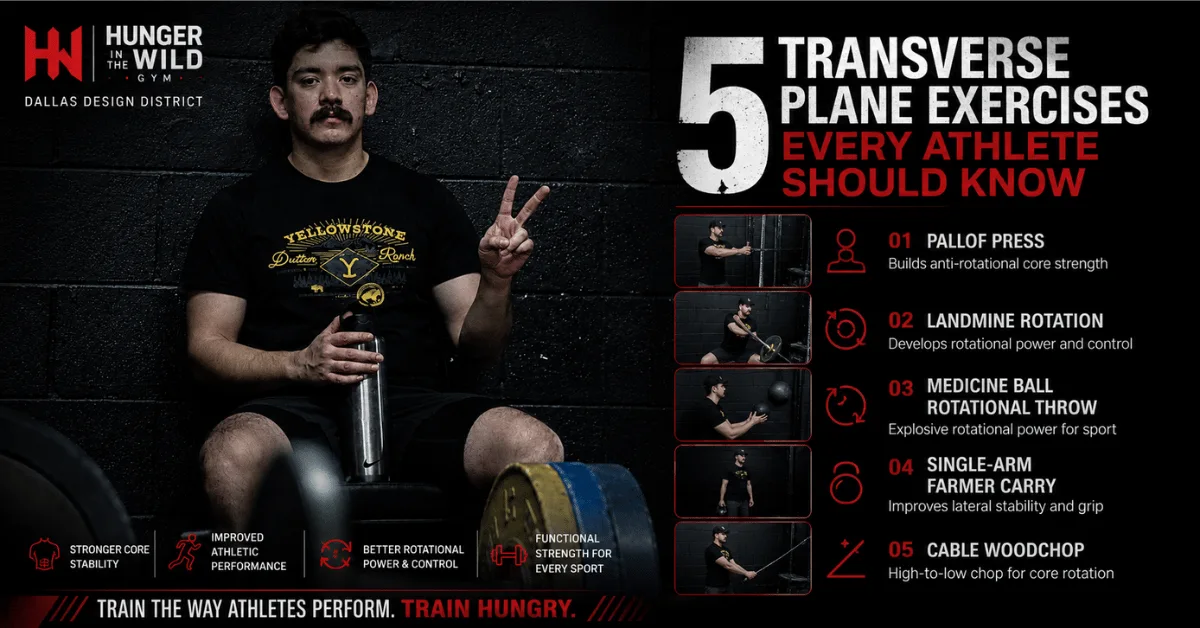
If you are not sure where to start, these five exercises cover the most important rotational and anti-rotational demands for strength and athletic performance.
You do not need to perform all five in every workout. Choose one rotational exercise and one anti-rotation exercise that complement the rest of your training, then progress the resistance, speed, or complexity as your control improves.
| Day | Placement | Exercise | Sets x Reps |
|---|---|---|---|
| Day A | Warm-up | Pallof Press | 2 x 10/side |
| Day A | Power | Med Ball Rotational Throw | 4 x 5/side |
| Day A | Accessory | Cable Woodchop | 3 x 10/side |
| Day B | Warm-up | Banded Dead Bug | 2 x 8/side |
| Day B | Accessory | Landmine Rotation | 3 x 8/side |
| Day B | Finisher | Single-Arm Farmer Carry | 3 x 40m/side |
| Plane | Direction | Examples | Key Muscles |
|---|---|---|---|
| Sagittal | Forward / Backward | Squat, deadlift, lunge, row | Quads, glutes, hamstrings, lats |
| Frontal | Side to Side | Lateral raise, side lunge, lateral shuffle | Adductors, abductors, lateral deltoids |
| Transverse | Rotational | Woodchop, Russian twist, Pallof press | Obliques, deep core, rotator cuff |
The transverse body plane is an imaginary horizontal line that divides the body into upper and lower halves at the waist. Any movement that involves rotation around the spine, or internal and external rotation of the limbs, occurs in this plane. It is also called the axial plane or horizontal plane.
Start with the Pallof press and the Russian twist. Both are low-impact, easy to learn, and teach the fundamental pattern of resisting and producing rotation. Once those feel comfortable, progress to cable woodchops and rotational lunges.
Two to three times per week is ideal. You do not need dedicated sessions. Add 2-3 transverse plane exercises to your existing workouts as warm-ups, accessories, or finishers.
Squats and deadlifts are primarily sagittal plane movements, but they do require anti-rotation stability in the transverse plane to keep the barbell tracking correctly. However, this passive demand is not enough to fully develop rotational strength. You still need dedicated transverse plane exercises.
Rotational exercises like medicine ball throws and woodchops produce twisting force through the torso. Anti-rotational exercises like the Pallof press and single-arm farmer carry resist twisting force. Both develop the transverse plane, and both should be in your program.
At Hunger in the Wild, our programming is built to develop complete athletes, not one-dimensional lifters. Every training cycle includes structured rotational and anti-rotation work alongside heavy compound lifts, Olympic weightlifting, and HYROX-specific conditioning.
If your current program is missing an entire plane of motion, a conversation with one of our coaches is a good place to start.
View Our Strength Training Classes