HYROX strength training in Dallas is the part of race prep that most amateur racers under-do, and it shows up at every sled, every sandbag, and every wall ball. The race itself is simple on paper: 8km of running with 8 functional workout stations, repeated in a fixed order. What looks like a runner’s event is actually a strength event with a heart-rate problem. The athletes who race well are not the ones with the fastest 5k. They are the ones who can keep moving heavy implements after their legs are already cooked.
If your last race ended with a 4-minute sled push that should have been 2, you are not under-conditioned. You are under-strong. At Hunger in the Wild Gym, an official HYROX Training Club in central Dallas, the coaching team builds programs that fix this gap by anchoring race prep in real strength work, with race-specific conditioning layered around it.
Also Read:
HYROX is decided at the strength stations, not the running. The sled push, sled pull, sandbag lunges, farmers carry, and wall balls reward absolute lower-body strength, posterior-chain power, grip endurance, and trunk stability. Most amateur racers train conditioning four or five times a week and lift once or twice, leaving them with a sled push that bleeds time and a sandbag lunge that turns into a slow grind. A real HYROX block puts coached strength work at the center: heavy squat and hinge patterns, loaded carries, single-leg work, and explosive lifts, programmed alongside running and station practice.
Strength is the limiter for most amateur HYROX racers in Dallas If your training mix is mostly running and circuit work, the fastest path to a faster race is a coached strength block. Book a free consultation and facility tour.

The HYROX race format is the same in every city: 1km of running, then a station, repeated eight times. The eight stations are SkiErg, sled push, sled pull, burpee broad jump, rowing, farmers carry, sandbag lunges, and wall balls. That format has not changed since 2017, and it is drawing more than 1.2 million expected athletes across 100-plus events in the 2025/26 season.
Five of the eight stations are pure strength expressions. Sled push and sled pull demand maximal lower-body force into the ground. Sandbag lunges combine load with single-leg stability. Farmers carry is grip and trunk endurance under load. Wall balls are a thrusters-style movement that fatigues legs and shoulders. Only the two ergs and the burpee broad jump sit closer to pure conditioning, and the broad jump still rewards hip power.
The time bleed for amateurs is concentrated in specific places. A sub-elite male racer can lose 2 to 3 minutes on a single sled push because his quads cannot produce enough force per stride. He does not need more zone 2 running. He needs a heavier back squat.
The old fear that lifting heavy will compromise endurance is mostly dated. A 2025 systematic review in Frontiers in Sports and Active Living concluded that concurrent strength and endurance training, when sequenced properly, produces complementary or synergic performance effects across team and endurance sports. The interference effect on maximal strength is small and can be reduced further by separating sessions or alternating days.
For HYROX athletes, this is liberating. You can lift heavy three days a week, run two to three times a week, and practice station work without losing strength gains. What you need is a program that respects the sequencing, not less lifting.
There is no exact 1-rep-max requirement to finish HYROX, but the patterns are clear. Men running sub-1:10 typically back-squat at least 1.5x bodyweight and deadlift 2x. Women running sub-1:20 sit in a similar relative-strength range.
Below those numbers, the sled stations and sandbag lunges start to dominate the race clock. This is where a Dallas-based strength training program earns its keep, with heavy compound lifts programmed across a 12 to 16 week block before the race.
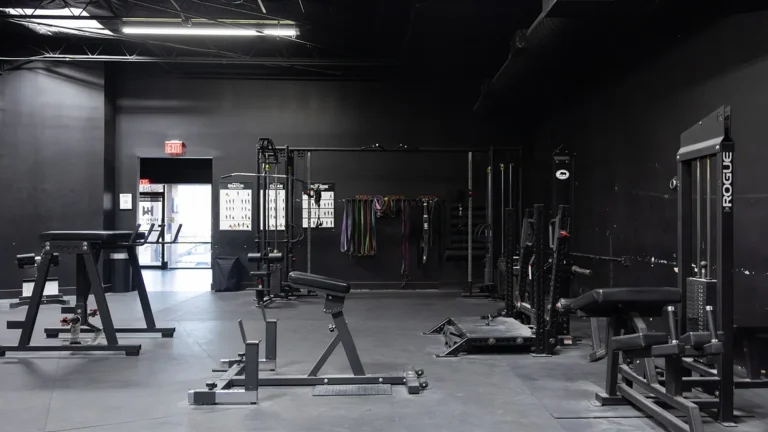
Tour the facility before you commit HITW sits in the Design District with dedicated lifting platforms, HYROX-spec equipment, and a full strength floor. Book a free consultation and facility tour.
This is the section most general fitness articles skip. Each station has a primary strength quality that determines your time, and a small set of gym lifts that build it. Get these right and your race time drops faster than another 5k PR ever will.
Sled push is the single largest time variable in a HYROX race for amateurs. The primary qualities are quad and glute strength, hip extension power, and the ability to put force into the ground at low angles. The lifts that build it: back squat, front squat, hack squat, and walking lunges with load. A 2014 study published in the Journal of Strength and Conditioning Research compared sled pushing to the back squat and found quad and hamstring activation during the sled push comparable to the back squat, confirming the heavy squat is your most direct carryover.
Sled pull is the same qualities with more emphasis on hamstrings, lats, and trunk. Pulling a heavy sled hand-over-hand is a closed-chain row under fatigue. The lifts that build it: Romanian deadlifts, conventional deadlifts, bent-over rows, and heavy farmer carries. The deadlift is the high-return movement.
The closest the race comes to a pure conditioning station, but the broad jump rewards horizontal hip power. Athletes who broad-jump further with control cover the 80 meters in fewer reps. The lifts that build it: trap-bar deadlifts, kettlebell swings, broad jumps, and Olympic lift derivatives. The HITW Olympic weightlifting program, the only dedicated program in central Dallas, builds explosive hip extension through the snatch and the clean & jerk.
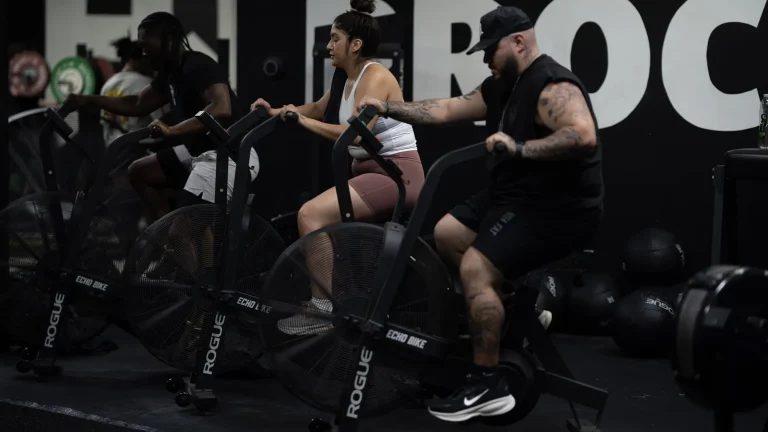
Both ergs reward strong pulls and an aggressive leg drive. Athletes who treat the row like a cardio piece bleed time. Athletes who treat it like a sequence of heavy pulls hold a faster split at a lower heart rate. The lifts that build it: deadlifts, hip hinges, pull-ups, and barbell rows.
The cleanest grip and trunk endurance test on the floor. The load is moderate. What kills the time is grip failure halfway through. The lifts that build it: heavy farmer carries above race load, axle bar holds, double-overhand deadlifts, and dead hangs. Train the carry above race load so race day feels controllable.
This is where female racers, in particular, see large time gains from strength work. The sandbag sits on the rear shoulders and forces a quiet, vertical trunk through 100 meters of forward lunges. The lifts that build it: back-rack walking lunges, split squats, Bulgarian split squats, and front-rack carries. A 12-week block of single-leg work is the most common reason a returning racer drops two minutes from a previous time.
The closing station, and the one most likely to break form. Wall balls combine a front squat and an explosive push press, repeated 100 times. The lifts that build it: front squats, push press, thrusters, and overhead carries. Programmed correctly, wall balls develop local muscular endurance and coordination, but the underlying strength has to be there or form falls apart by rep 40.
Talk to a coach about your race timeline The right block depends on how many weeks you have. Schedule a free consultation and a coach will map your program against the date.
Hunger in the Wild runs HYROX-specific programming on a periodized model, not a random circuit-of-the-day model. The strength block sits at the center, with running and station work layered around it.
A typical week for a Dallas racer 12 weeks out looks like this. Three coach-led strength sessions hit the primary lifts: back squat, front squat, deadlift, Romanian deadlift, push press, and pull variations. Two running sessions are structured around tempo and intervals, not easy miles. One to two station-practice sessions run the actual race movements at race load.
The HITW coaching team draws on owner Kyle Dosterschill’s background as a USAW Level-2 National Coach and the experience of coaches who race HYROX themselves. Classes are capped to a size where the coach can correct your front-rack position on a sandbag lunge before the third rep, not the thirtieth.
Across a 12-week prep, the strength work moves through phases. Weeks 1 to 4 emphasize hypertrophy and movement quality, with moderate loads and higher rep ranges. Weeks 5 to 8 shift toward absolute strength, with heavier loads in the 75 to 90 percent range. Weeks 9 to 12 taper volume while preserving intensity, and the station-specific work gets sharper.
This is the same progression model that Hunter McIntyre’s HYROX PRO program uses for elite athletes, scaled for working professionals in Dallas. The principles are consistent: strength first, then specificity.
The running and erg work happens through a dedicated engine training program that respects the concurrent-training research. Easy running sits at conversational pace. Hard sessions are concentrated and short. For racers who want one-on-one attention on technique or programming, personal training with a HYROX-experienced coach is available alongside the small-group classes.
Consider a 35-year-old professional in Oak Cliff who finished her first HYROX last year in 1:34. Her splits showed a 4-minute sled push, a 5-minute sandbag lunge, and a 9-minute wall-ball station. She runs four times a week and lifts maybe once.
Her aerobic base is fine. Her strength is the constraint. A 12-week block focused on back squat, deadlift, front-rack carries, and single-leg work, with running scaled to two structured sessions, would realistically take 8 to 12 minutes off her finishing time. The ACSM’s 2026 resistance training position stand recommends at least two days of resistance training per week for healthy adults targeting all major muscle groups, and competitive race prep sits at the higher end of that recommendation.

These habits separate finishers who improve year over year from finishers who plateau.
A coached environment makes these habits stick. Random gym work drifts back to whatever feels comfortable, which is usually the movements you are already good at.
HYROX rewards real strength more than any other mass-participation race in the sport. Eight stations, five dominated by force production and load tolerance, decide the day. Athletes who treat HYROX as a running event with accessory work leave 5, 10, sometimes 15 minutes on the table.
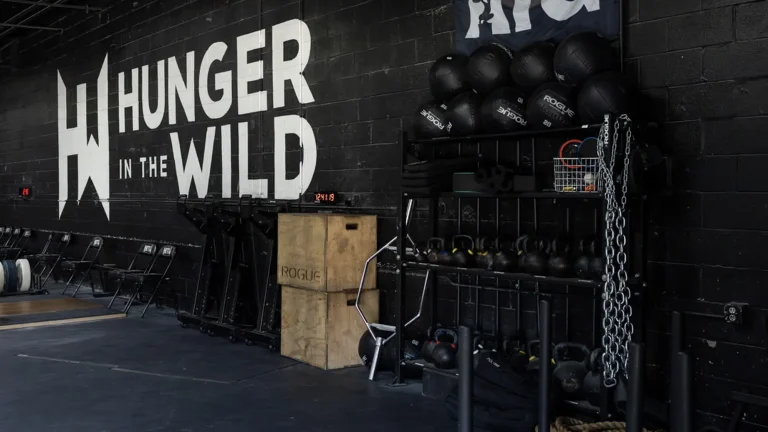
Hunger in the Wild Gym was built for the Dallas athlete past the random-workout phase who wants structured, coach-led strength programming with HYROX-specific application. Owner Kyle Dosterschill and the HITW coaching team run small-group classes capped for real per-rep feedback, with one-on-one personal training and the dedicated Olympic weightlifting program in central Dallas. The facility sits in the Design District with HYROX-spec equipment, dedicated lifting platforms, and 24/7 access for members.
Build the strength block your race needs HITW’s HYROX program is built around the lifts that drive sled times, sandbag splits, and wall-ball stations. Book a free consultation and facility tour, meet a coach, and decide from there.