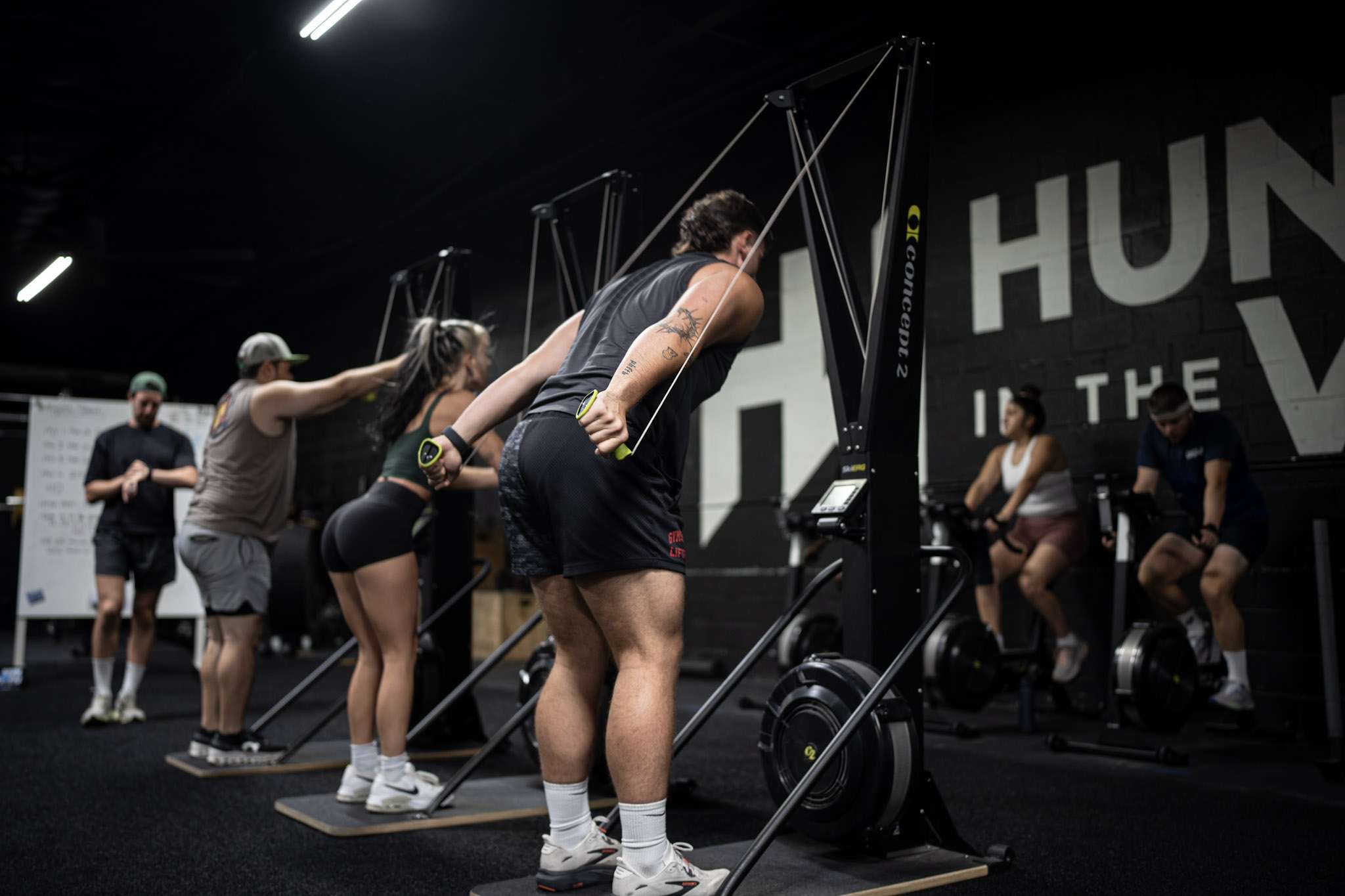
You don’t need six training days a week to race a good HYROX. You need three sessions that each do a specific job, and the discipline to stop trying to fit a full-time athlete’s calendar into a full-time life.
Most HYROX plans assume five or six days a week. That works if your schedule is flexible. It falls apart when you work long hours, travel, or have a family that needs you most evenings. This guide covers whether three days is enough, what each session should do, a realistic sample week, and what to do when a week falls apart.
If this is your first race, start with our first-race guide for the basics, then come back here to fit it into three days.
Yes, if your goal is to finish strong and race well for your current fitness. Three well-built sessions a week can prepare you for an Open or Doubles race. They won’t squeeze out every last minute the way a five- or six-day plan can, so be honest about which goal you have.
The race is eight 1 km runs, each followed by a station (see our guide to all 8 HYROX stations and HYROX weights by division). It rewards consistent, race-specific training more than sheer weekly volume. With three days, you cut extra accessory work, easy filler miles, and long mobility sessions, and keep three priorities:
Drop any one of those and three days stops being enough.
If that’s you, keep the three-day structure and add one easy run or a short strength session. Don’t add a fourth all-out workout.
To show how the plan adapts, we’ll follow two examples.
Maya is training for her first HYROX. She works long days, signed up for Open because a friend wouldn’t stop talking about the finish line, and can run a 5K without stopping. She has never pushed a competition sled. Her goal: finish proud and run every kilometer.
Derek is racing for time. He finished his first Open race in about 95 minutes and wants to break 85. He travels for work and used to make up missed sessions by stacking two hard days back to back, which left him flat and sore. His goal: steady training that survives a messy calendar.
Same three-session structure, different emphasis inside each day.
Give each session a role. Every week, you train your engine, your strength, and the race itself.
What it does: builds the aerobic fitness that carries you through 8 km of running and every station.
Length: 45 to 70 minutes.
Choose one focus each week and rotate as race day gets closer:
Maya: mostly easy aerobic work early on. Once she can hold good form when tired, she adds 1 km repeats.
Derek: one tempo or interval week for every two easy weeks. He already has the base; he needs quality, not extra miles.

What it does: makes race weights feel lighter by making you stronger.
Length: 50 to 70 minutes, with full rest between sets and no conditioning finisher.
Build it around a squat, a hinge, single-leg work, upper-back pulling, and a heavy carry to finish. For exercise choices and loading, see strength training for HYROX.
On a three-day plan, the key is what you leave out. Train heavy and skip the conditioning workout tacked on at the end. Hard strength work and hard conditioning draw on the same recovery, and with only three days you have none to spare.
Maya: learns solid positions first, then builds up to race-weight sleds and carries.
Derek: keeps his main lifts and adds sled push, sled pull, and sandbag lunges at race weight or slightly heavier, with full rest.

What it does: trains you to race, not just to do the pieces.
Length: 50 to 75 minutes.
This is the session you never skip, because it’s the only one that practices compromised running: running right after a station, when your legs and lungs are already working hard. On race day you never run fresh after the first kilometer, so this is where three-day athletes gain the most.
Each Session C includes:
A sample block at Open weights:
Rest enough between rounds to keep your technique sharp. The goal is skill under fatigue, not the highest heart rate you can hit. Use these rounds to rehearse your race pacing too; our HYROX pacing strategy guide has target splits.
You don’t need a full race simulation every week. They take a lot out of you. A half simulation (4 runs and 4 stations) every two to three weeks is plenty on this plan.
Here’s a realistic week for someone with a Monday to Friday job. Move days around for travel, but keep each session’s role and never put two hard days back to back.
| Day | Session | What to do |
|---|---|---|
| Mon | A: Engine | 45 to 50 min easy aerobic run, or 6 x 1 km at Race Pace with 2 to 3 min easy jog between |
| Tue | Off | Easy 20 to 40 min walk |
| Wed | B: Strength | Squat, hinge, single-leg, pull, farmers carry. Full rest between sets |
| Thu | Off | Optional 15 min mobility |
| Fri | Off | Buffer for travel or a long workday |
| Sat | C: Race-specific | Run and station pairings or a coached HYROX class. Half simulation every 2 to 3 weeks |
| Sun | Rest | Full rest |
Total hard training: about 2.5 to 3.5 hours a week. That’s enough for a strong first race and a real improvement in your second, as long as you get all three sessions in.
| Maya (first race, about 12 weeks out) | Derek (chasing sub-85, about 8 weeks out) | |
|---|---|---|
| Mon | 45 min easy aerobic run | 6 x 1 km at goal Race Pace |
| Wed | Strength, learning sled and carry positions at moderate weights | Strength, plus sleds and lunges at race weight or heavier |
| Sat | Coached HYROX class focused on SkiErg, sleds, and wall balls | Half simulation every other week; fast-transition pairings between |
| Targets | Jog every run, carry in long unbroken chunks, planned wall ball sets | Even run splits, sleds that never stop, wall balls in sets of 15 to 20 |
When travel or work wrecks the calendar, keep sessions in this order of priority:
One day available? Do a shorter Session C. Two days? B and C. Never stack two hard sessions on consecutive days to catch up. That’s how busy athletes end up flat or hurt.
Walk more, sleep 7 to 9 hours when you can, eat enough protein and carbohydrates to recover, and do one short mobility routine for hips, ankles, and upper back. None of that counts as a fourth workout. It’s what lets three sessions add up.
Fewer days a week means you need more weeks, not fewer.
| Starting point | Suggested training time |
|---|---|
| New to training or training inconsistently | 14 to 16 weeks |
| Fit but new to HYROX | 10 to 12 weeks |
| Raced before | 6 to 8 weeks |
Every three to four weeks, take a lighter week: same three sessions, about a third less work. In the final 7 to 10 days, keep some intensity, cut the volume, and prioritize sleep.
These are the mistakes specific to training on a short week. For the full list, see common HYROX training mistakes.
HYROX doesn’t take over your life. It takes a plan you can keep.
At Hunger in the Wild Gym, an official HYROX Training Club in Dallas, our Engine, Strength, and HYROX classes line up with the three sessions in this plan, coached on race-standard equipment. We’ll show you around, talk through your race goals, and help you plan a training week you can keep.
Book a Free ConsultationYes. For most recreational athletes aiming to finish an Open or Doubles race well, three focused days a week is enough. It’s less ideal if you’re chasing top age-group times or racing Pro without a strength base.
The race-specific day (Session C). It’s the only session that practices running straight off a station, which is what race day demands. If you only get one session in a week, make it that one.
Not necessarily. Easy walking is better than forced extra miles. If you add a fourth day, make it an easy aerobic run, not another hard session.
You can, but you’ll get more from one class or race-specific session, one strength day, and one engine day. Three race-style workouts a week leave strength and aerobic fitness undertrained.
A half simulation every two to three weeks, plus one fuller rehearsal a few weeks before race day. Doing more costs recovery you don’t have on three days. For race-day logistics, see what to expect at your first HYROX.