You have probably heard someone at your gym talking about it. Maybe a coworker mentioned they are “training for a HYROX.” Maybe you saw the videos — hundreds of people running, pushing sleds, rowing, and finishing through a tunnel of red lights while a crowd loses its mind.
And your first thought was probably: what is this, and could I actually do it?
HYROX is a standardized indoor fitness race that combines running with functional workout stations. It is the same format at every event, everywhere in the world, and it is open to anyone — from competitive athletes to people who have never raced anything in their lives.
As the head coach of Hunger in the Wild, an official HYROX Training Club in Dallas, I have coached athletes through their first race and their tenth. This guide covers everything you need to know about the sport before you sign up, start training, or just figure out what your friends keep talking about.
Even for HYROX athletes, developing a stronger foundation can improve performance across demanding race stations, and Hunger In The Wild’s Olympic Weightlifting Gym in Dallas provides structured training for athletes looking to build strength and power.
Every HYROX race follows the exact same structure. You run one kilometer, then complete a functional workout station. Then you run another kilometer and complete the next station. This pattern repeats eight times — eight runs and eight stations — for a total of eight kilometers of running plus the work at every station.
The stations always come in the same order, the distances never change, and the weights are fixed by division. This is what makes HYROX different from nearly every other fitness competition: you know exactly what is coming, and you can train for it with precision.
A typical race takes most people between 75 and 100 minutes. There is no time cap. You can walk, rest, and take as long as you need. Nobody gets cut. You start, you finish, and you get an official time that you can compare to every other HYROX athlete on the planet.
Here is what you will face on race day, in order:
Station 1 — SkiErg (1,000 meters). An indoor machine that mimics the motion of cross-country skiing. It is a full-body movement that hits your lats, core, and legs. This is the first station, so you are fresh — but going too hard here is the most common mistake first-timers make.
Station 2 — Sled Push (50 meters). You push a weighted sled across a competition floor. The surface creates significantly more friction than what you experience in most gyms, which catches a lot of people off guard. Body angle is everything — stay low and drive with your legs.
Station 3 — Sled Pull (50 meters). Same sled, but now you are pulling it toward you using a rope, hand over hand. This taxes your grip, back, and posterior chain. If your hands are burning by the end, you are doing it right.
Station 4 — Burpee Broad Jumps (80 meters). You perform a burpee, then broad jump forward, and repeat until you have covered 80 meters. This is the station that breaks the most people mentally. It is not technically difficult — it is just relentless.
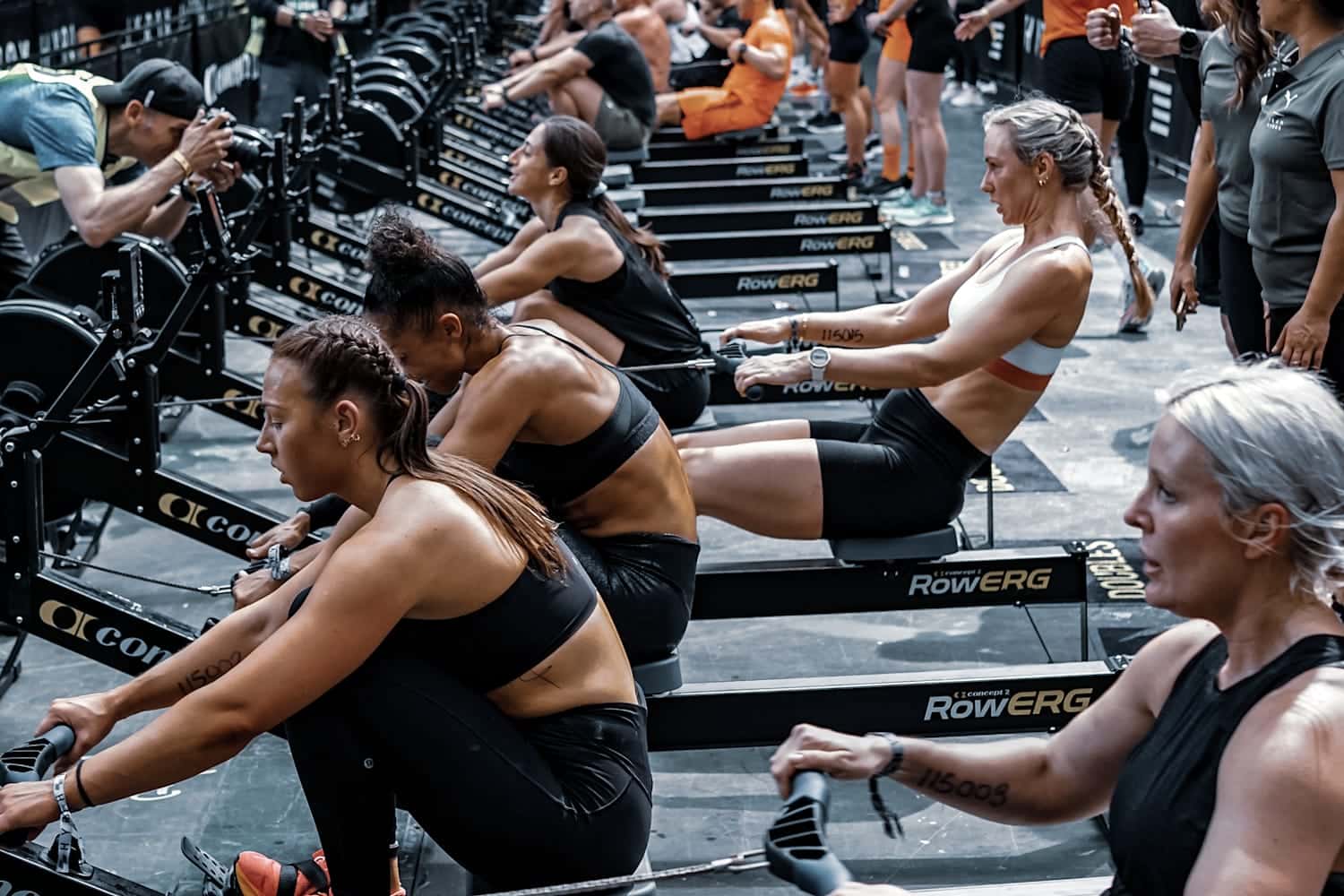
Station 5 — Rowing (1,000 meters). A standard rowing machine for 1,000 meters. By this point, you are halfway through the race and fatigue is real. Pacing matters more than power.
Station 6 — Farmers Carry (200 meters). Pick up two heavy kettlebells and walk 200 meters. Grip endurance is the limiting factor for most people. You can set them down, but every time you do, you are losing time.
Station 7 — Sandbag Lunges (100 meters). A sandbag goes on your back and you lunge for 100 meters. Your quads will be screaming. If you set the sandbag down, you receive a time penalty — so pacing from the start is critical.
Station 8 — Wall Balls (100 reps). You squat with a medicine ball and throw it to a target on the wall. One hundred times. This is the final station, and it is the one you will remember. With the finish line in sight, it becomes as much a mental challenge as a physical one.
After your last wall ball, you run through the finish chute — usually through the signature red light tunnel with the crowd on both sides. It is one of the best finishes in any race format, and it is the moment that hooks most people for good.
One of the reasons HYROX has grown so fast is that it is genuinely built for all levels. You do not need to qualify, and you do not need to be an elite athlete. You pick the division that fits your experience and goals.
Open is where most people start. You race solo, and the station weights are moderate — designed to be challenging but achievable for anyone with a base level of gym fitness.
Pro uses heavier station weights and is designed for competitive athletes who are chasing faster times and leaderboard rankings.
Doubles lets you race with a partner. You split the running and stations however you want, and you must cross every finish line together. This is a great entry point if you want to share the experience and divide the workload. If you’re weighing it against racing solo, our HYROX doubles vs singles guide breaks down which one to race first.
Relay is a team of four. Each person takes on two stations and two runs. This is the most social and beginner-friendly format.
Age Group divisions run within Open and Pro, so you are ranked against athletes in your age bracket — from under-24 all the way through 70-plus.
The station weights change depending on your division, but the format stays the same. Every HYROX athlete — from a first-timer in Open Doubles to an Elite 15 qualifier — runs the same course and hits the same stations.
This is one of the most common questions I get, and the answer is simpler than people expect.
CrossFit competitions change the workouts for every event. Athletes do not know what they will face until right before they compete. The movements can include gymnastics, Olympic lifts, and highly technical barbell work. The variability is the point.
HYROX is the opposite. The format never changes. The stations are the same at every race, everywhere in the world. You always know exactly what is coming, which means your training can be specific and your progress is measurable from race to race.
The movements in HYROX are also intentionally straightforward — pushing, pulling, rowing, running, lunging, squatting, throwing. You do not need to spend months learning a muscle-up or a snatch before you can compete. If you can move your body and carry weight, you can do a HYROX.
The other major difference is that HYROX is an endurance event. Most races last between 60 and 100 minutes. That is closer to a half-marathon than a CrossFit workout. Pacing, energy management, and the ability to perform under sustained fatigue are what separate a good HYROX time from a great one.
Neither sport is better or worse — they test different things. But if you are someone who likes to train for a specific event, measure your progress with precision, and compete against a global leaderboard, HYROX is built for exactly that.
You do not need to be a runner or a competitive athlete to start training for HYROX. You need a base level of fitness — the ability to jog a kilometer without stopping, perform basic movements like squats and lunges under load, and sustain effort for more than a few minutes.
From there, HYROX training develops three things simultaneously:
Running endurance — specifically the ability to run repeated kilometers under fatigue. This is not the same as training for a 10K or a half marathon. In HYROX, you never run fresh after the first kilometer. You run after pushing a sled, after rowing, after 80 meters of burpee broad jumps. This is called compromised running, and it is the single most important thing to practice.
Strength endurance — the ability to produce moderate force over and over again. You do not need a 400-pound squat to do well at HYROX. You need the ability to push race-weight sleds smoothly, carry heavy kettlebells without your grip failing, and squat a medicine ball 100 times when your legs are already cooked.
Pacing and race management — knowing when to push, when to hold back, and how to distribute your energy across 60-plus minutes of continuous work. The athletes who win HYROX races are not the ones who go out fastest. They are the ones who slow down the least.
If you want a detailed breakdown of how to structure your training, I wrote a full guide here: How to Train for HYROX: A Coach’s Guide to Your First Race.
HYROX started in Hamburg, Germany in 2017 with 650 participants at its first event. The 2025/2026 season is projected to see over one million participants across more than 100 events worldwide. That kind of growth does not happen by accident.
The sport tapped into something that was missing in fitness: a race for gym-goers. Runners had marathons. Swimmers had open water events. Cyclists had gran fondos. But if your primary training happened inside a gym — pushing, pulling, squatting, carrying — there was no standardized competition built for you. HYROX filled that gap.
The format is simple enough to explain in one sentence but challenging enough to keep people coming back season after season. The standardized course means your time always means something. And the atmosphere on race day — the music, the crowd, the red light tunnel, the energy of hundreds of people racing at the same time — creates an experience that most people describe as addictive.
It also helps that the barrier to entry is low. You do not need to qualify. You do not need specialized skills. You sign up, you train, and you race. Most people who do one HYROX are already planning their next one before they finish.
Dallas has become one of the strongest HYROX markets in North America. HYROX Dallas 2026 returns to the Kay Bailey Hutchison Convention Center November 18–22, expanded to five full days of racing due to demand. Tickets tend to sell out quickly.
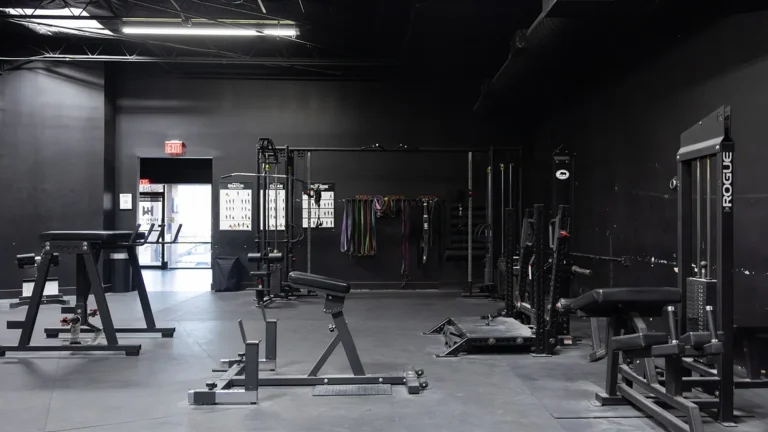
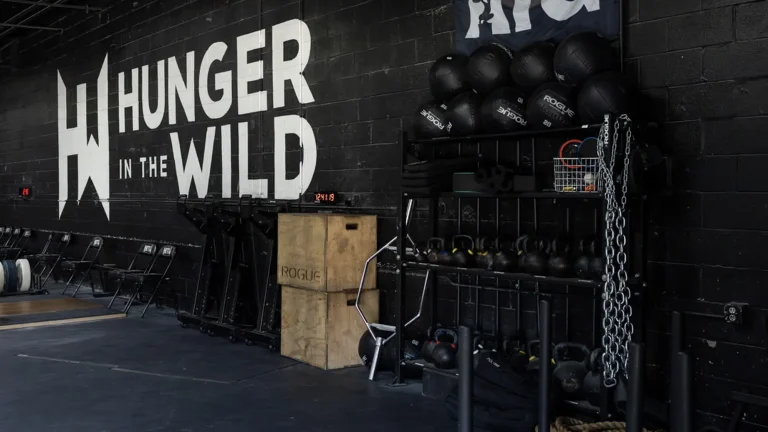
If you are training in the Dallas area, having access to race-standard equipment — the same sleds, SkiErg, rower, wall ball targets, and sandbags you will face on race day — makes a significant difference in your preparation. Practicing on the actual equipment eliminates the surprises that derail first-timers.
Hunger in the Wild is Dallas’s official HYROX Training Club in the Design District. We run coached HYROX classes with structured programming that builds running endurance, station efficiency, and race-day pacing. Whether you are preparing for your first race or trying to break into the Pro division, the training is designed to meet you where you are.
If you have read this far, you are probably at least curious. Here is what I would tell you if you were standing in front of me right now:
You are ready enough. The fitness you have today is enough to start training. HYROX is not something you need to be “in shape for” before you begin — the training itself gets you there.
Pick a race. Having a date on the calendar changes everything. It turns vague intentions into a real training plan with a real deadline.
Get into a structured program. Random gym sessions will not prepare you for the specific demands of HYROX. You need compromised running, station practice at race weights, and a plan that builds your capacity progressively over 12 to 16 weeks.
If you are in Dallas, book a free consultation and come see the gym. We will walk you through the stations, talk about your goals, and help you figure out which race and division makes sense for your first one.
The best time to start was three months ago. The second best time is today.
Ready to start training for HYROX?
Book a Free Consultation | View HYROX Class Schedule | Explore All Classes