If you’re eyeing your first HYROX and a friend wants in, the question comes up fast: race it solo, or as a doubles team? They’re genuinely different events — different pacing, different strategy, different pain. This guide covers exactly how doubles works, how much faster it is than singles, and a clear “pick this if” so you and your partner can decide with confidence.
The runs are identical. The stations are where it splits. Here’s the head-to-head:
| Singles | Doubles | |
|---|---|---|
| Running | You run all 8 × 1km | Both partners run all 8 × 1km together |
| Station work | You do 100% of every station | Split between partners, any way you choose |
| Weights | Your division’s load | Same load as the equivalent singles division |
| Total distance | 8km run + 8 full stations | 8km run + 8 half-shared stations |
| Typical field | Solo athletes chasing a time | Friends, couples, first-timers, teammates |
The single most important thing to understand: in doubles, you still run every meter. Both partners cover all 8 kilometers, and you have to stay within 15 seconds of each other on every run. What you split is the station work — the sled, the wall balls, the burpees. That’s why doubles is faster but not “half a race.”
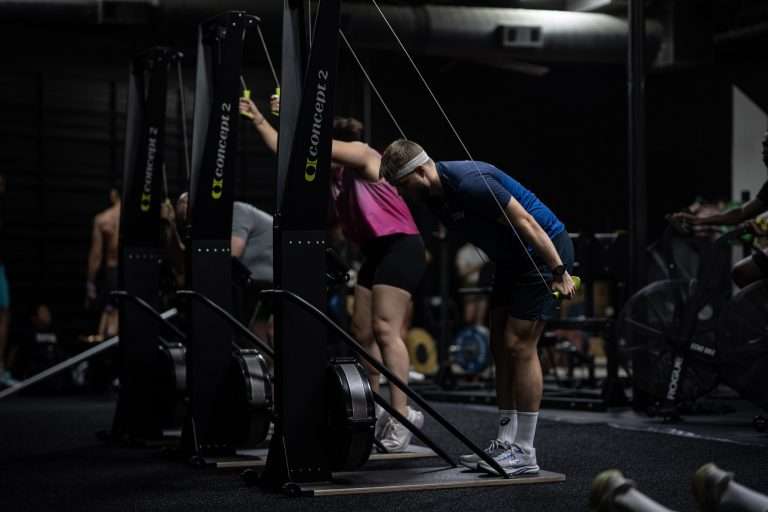
HYROX gives doubles teams almost total freedom on the stations. You can alternate reps (“you go, I go”), split each station down the middle, or have one partner smash a whole station while the other recovers for the next. Only one of you works at a time, and you swap whenever you want. New to the sport? Our overview of what HYROX is walks through the full race format first.
Smart teams don’t split everything 50/50. They split to strengths: the stronger presser takes more wall balls, the better engine takes more of the erg, and you plan swaps at natural break points so nobody redlines. The weights don’t change from singles — a doubles team uses the same loads as the equivalent Open division — so strength still matters, you just share the volume. (For the exact loads, see our HYROX weights by division tables.)
Meaningfully faster, because you’re splitting station volume while the running stays the same. Rough average finish times tell the story:
| Division | Average finish |
|---|---|
| Open Men (singles) | ~1:28 |
| Men’s Doubles | ~1:14 |
| Open Women (singles) | ~1:38 |
| Women’s Doubles | ~1:26 |
That’s roughly 12–15 minutes faster on average — the time you’d otherwise spend doing the second half of every station. But don’t mistake faster for easier: because you rest less between your working efforts and the runs never stop, well-run doubles teams push a higher intensity than they would solo. The pain is just distributed differently.
It’s your first race and you want the experience with less total station volume. You have a training partner or want to race with a friend or partner. You’re coming back from a layoff and want to ease in. Or you simply find the sport more fun shared — which, for most people, it is. Doubles is the friendliest on-ramp to HYROX there is.
You want a pure, comparable-to-the-world benchmark of your own fitness. You’re chasing a specific time or a competitive placing. Your schedule makes coordinating a partner’s training hard. Or you just want the full, unshared test — there’s something clarifying about knowing every rep was yours.
Plenty of athletes do both across a season: doubles to race with friends and singles to test themselves. There’s no wrong first choice — and if you’re not sure, doubles is the lower-pressure place to start — including at HYROX Dallas 2026.

The two things that separate smooth doubles teams from chaotic ones:
Nail the runs. That 15-second rule means the faster runner can’t just take off. Run side by side at the slower partner’s sustainable pace, and treat the run exactly like a solo racer would — as recovery, not a race. Pacing discipline matters even more in doubles because you’re managing two engines; the same principles from our HYROX pacing strategy guide apply directly.
Rehearse your swaps. The transitions at each station are where doubles teams lose or gain a minute. Decide in advance who starts each station, how you’ll split it, and what the verbal cue to swap is. A team that has practiced its changeovers moves like one athlete; a team improvising loses seconds every station. This is exactly the kind of thing our HYROX race team in Dallas drills together, and it’s a core part of what our HYROX classes prepare you for — on real competition equipment, with a partner.
Yes. Both partners run every one of the eight 1km segments together, and you must stay within 15 seconds of each other. You never split the running — only the station work is shared.
However you want. Only one partner works a station at a time, and you can swap freely — alternate reps, split each station in half, or have one partner do a whole station while the other rests. Smart teams split by strengths rather than exactly 50/50.
Faster, but not necessarily easier. You split the station volume, which cuts roughly 12–15 minutes off an average finish, but you rest less between efforts and still run all 8km — so good teams race at a higher intensity than they would solo.
No. Doubles teams use the same weights as the equivalent singles Open division — same sled, same wall ball, same kettlebells. You share the volume, not a lighter load.
Doubles is the friendlier first race for most people: less total station work, a partner to share the experience, and lower pressure. Choose singles first only if you specifically want a pure, unshared benchmark of your own fitness.