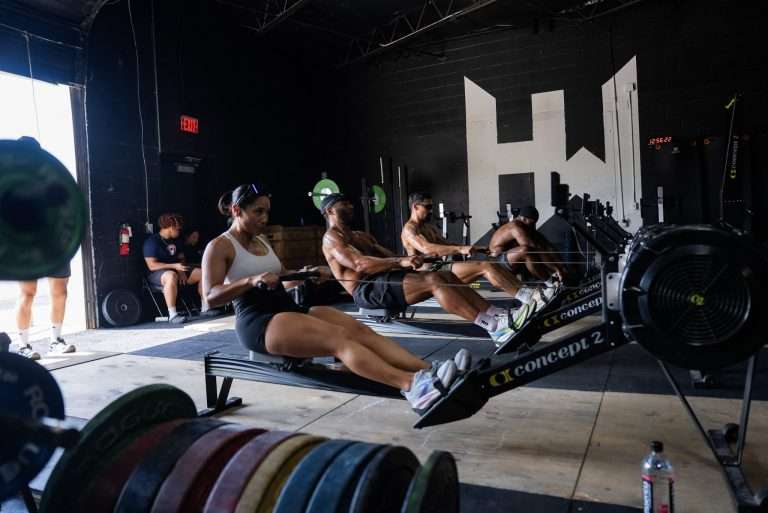


A hybrid athlete is someone who trains for strength and endurance at the same time instead of specializing in one. Hybrid training is how you organize that work: heavy lifting, machine and running conditioning and some mixed sessions, all in one plan so each quality supports the others. The challenge is balance. Endurance work can blunt some strength gains if you stack it carelessly, but the research suggests that with smart scheduling, most people can build both. This guide covers what hybrid training is, what the interference effect really says, how we balance the two and what sample weeks look like for different athletes.
The term has no official definition, so here’s ours. A hybrid athlete is someone whose goals need both strength (lifting heavy, building muscle, producing force) and endurance (holding a hard effort for a long time). A powerlifter who also wants to run a 10K is a hybrid athlete. So is a marathoner who lifts twice a week, a HYROX racer, a CrossFit-style competitor or a 45-year-old who wants to deadlift well and still hike all day.
Researchers use similar language. A 2025 scoping review of 39 studies mentions the rise of “hybrid competitions” such as CrossFit and HYROX, and describes HYROX as a race format that combines strength and endurance tasks in a fixed structure. HYROX itself is eight 1 km runs, each followed by a functional workout station: SkiErg, sled push, sled pull, burpee broad jumps, rowing, farmers carry, sandbag lunges and wall balls.
Here’s how a hybrid athlete compares with a specialist:
| Strength specialist | Endurance specialist | Hybrid athlete | |
|---|---|---|---|
| Main goal | Lift as much as possible | Go as far or as fast as possible | Be strong and fit at once |
| Rough weekly pattern | 3 to 5 lifting days, little cardio | 4 to 6 days of running, cycling or rowing | 2 to 3 strength days plus 1 to 3 conditioning days |
| Trade-off | Less engine | Less muscle and maximal strength | Rarely the best at either extreme |
| Edge | Peak strength and size | Peak aerobic capacity | Strong, fit and resilient across many tasks |
Hybrid athletes accept that they won’t have the biggest squat in the building or the fastest marathon. In return, they get a body that handles real life, and races like HYROX, very well.
To keep this practical, we’ll follow three made-up athletes through the article. They aren’t real HITW members, and their weeks are illustrations, not results.
Hybrid training is a program that deliberately combines strength training and endurance training in the same week, and it often adds mixed sessions that blend the two. That’s different from “doing a bit of everything,” because every session has a specific job.
A hybrid week usually has four building blocks:
Our HYBRID program in the online membership follows this idea: three to six days a week of heavy lifting, with running and conditioning days alongside. If you’d rather train in person, our Engine classes cover the conditioning side on machines.
You stay healthier. In a 2014 systematic review and meta-analysis of 25 randomized trials with 26,610 participants, strength training was associated with a much lower injury risk (relative risk 0.315, meaning roughly two thirds fewer injuries), and the authors concluded that strength training reduced sports injuries to less than a third. Those trials weren’t of hybrid athletes specifically, but it’s one reason strength comes first in our programs: a stronger athlete tolerates more running, more stations and more of everyday life.
You build a bigger fitness base. The World Health Organization’s 2020 guidelines recommend that all adults do 150 to 300 minutes of moderate-intensity (or 75 to 150 minutes of vigorous-intensity) aerobic activity each week, plus regular muscle-strengthening activity. A hybrid week covers both.
You’re ready for events. In our experience, people who train both qualities find it easier to sign up for a HYROX or a half marathon whenever the mood strikes.
If you’ve spent time around lifters or runners, you’ve heard that “cardio kills your gains.” The scientific version of that idea is the interference effect, also called the concurrent training effect: combining endurance and strength training can blunt some strength, size or power adaptations compared with strength training alone, according to a 2014 review in Sports Medicine. The same review notes that the training variables that seem to matter are the order of exercise within a session, the recovery between the two types of work, the volume and intensity of the endurance work and the type of endurance exercise.
Here’s what the evidence says in plain terms.
A 2012 meta-analysis in the Journal of Strength and Conditioning Research pooled 21 studies and compared strength-only, concurrent and endurance-only training. Strength-only training had the largest average effects, concurrent training came second and endurance-only training came last. For strength and muscle size, strength-only and concurrent training were both significantly better than endurance-only, but the authors didn’t find a significant gap between the two. For power, all three groups differed significantly:
| Outcome (effect size) | Strength only | Concurrent | Endurance only |
|---|---|---|---|
| Strength | 1.76 | 1.44 | 0.78 |
| Muscle size | 1.23 | 0.85 | 0.27 |
| Power | 0.91 | 0.55 | 0.11 |
The analysis also found that the interference depended on the type, frequency and duration of the endurance work. Running, but not cycling, was associated with significant decrements in size and strength, and more frequent and longer endurance training was associated with smaller gains.
A newer 2022 systematic review and meta-analysis in Sports Medicine covered 43 studies and compared strength training alone with strength plus aerobic training. It found no compromise in maximal strength or muscle growth when aerobic work was added. Explosive strength was the exception: gains were smaller in the concurrent groups, and the attenuation was more pronounced when both were done in the same session than when sessions were separated by at least 3 hours. The type of aerobic training (running or cycling), the number of weekly sessions, training status and age (under or over 40\) did not significantly change the results.
Another review in Sports Medicine argues the evidence for interference on muscle growth “is not as compelling as previously thought” and suggests that, under some conditions, concurrent exercise can even help.
In a 7-week study of 58 amateur rugby players, strength gains were lower when the aerobic and strength sequences were done back to back than when they were separated by 6 or 24 hours. The authors suggested avoiding scheduling two contradictory qualities with less than 6 hours between them. That’s one study in one sport, but it fits what we see: when you can separate the work, you should.
These are the rules we use at Hunger in the Wild Gym. They’re general guidance, not a prescription, and they should flex around your age, history and goals.
When a week gets crowded, strength is the last session we cut. Heavy squats, hinges, presses and pulls build the tissue that absorbs the pounding of running and the grind of the stations. If you’re also training for HYROX, strength training for HYROX goes deeper on which lifts to do and how heavy to go.
The SkiErg, RowErg and BikeErg give you serious conditioning without the repeated impact of running, so your legs stay fresh for the next lift. That’s why our Engine classes are machine-only for most of the year, with running added in steps as a race approaches. For more on easy aerobic work, see our Zone 2 guide for HYROX.
Put heavy lower-body lifting and hard running or engine intervals on different days. If you have to double up, lift first when strength is the priority for the day, and do the conditioning at least several hours later if your schedule allows.
Hybrid training falls apart when every session is medium-hard. Keep one or two days a week truly easy (a walk, an easy spin on the BikeErg or mobility work) so your hard days stay productive. Our training and recovery guide explains how to adjust your workouts when you feel flat.
For most athletes, two hard conditioning days a week is plenty. One can be tempo-style machine intervals and the other a mixed session with stations. Add a third only if your sleep, food and joints can handle it.
A full HYROX simulation is a test, not a weekly workout. We program about one a quarter, which usually means 1 to 2 full simulations and 2 to 3 partial ones in a year. In between, shorter practice sessions with runs and stations keep your pacing sharp. Our HYROX workouts guide has examples.
Training for both strength and endurance takes a lot of fuel and recovery. Fuel your sessions, eat enough protein and treat sleep as part of your training. Our performance nutrition guide is a good place to start.
These are sketches that show how the rules above fit different schedules. They aren’t a complete program: there’s no progression, no loads and no long-term periodization. Each athlete is fictional.
| Day | Session |
|---|---|
| Day 1 | Lower-body strength: squat pattern, single-leg work, core |
| Day 2 | Upper-body strength, then 15 to 20 minutes of easy BikeErg |
| Day 3 | Engine: RowErg, SkiErg and BikeErg intervals, with one easy station circuit if energy is good |
| Other days | Walks and mobility |
Andre’s priority is consistency. He lifts twice and builds his engine once. If he gets a fourth day, it becomes another easy machine session, not a harder one. Our HYROX training 3 days a week guide has a version for HYROX racers.
| Day | Session |
|---|---|
| Monday | Lower-body strength (squat focus) |
| Tuesday | Engine: machine intervals at a tempo effort |
| Thursday | Upper-body and pulling strength |
| Saturday | Mixed conditioning: carries, sled and a short machine circuit |
Maya’s strength days stay protected. Her engine work stays on machines, so her legs recover between lifts. As she gets comfortable, we’d add a short easy run, not a second hard run.
| Day | Session |
|---|---|
| Monday | Lower-body strength plus a short sled finisher |
| Tuesday | Running: tempo intervals |
| Wednesday | Easy aerobic work on a machine or a short easy run |
| Thursday | Upper-body strength plus a station finisher |
| Saturday | Race-style conditioning: runs and stations back to back |
| Friday and Sunday | Rest or an easy walk |
Nora’s week has more running because her race is getting closer. She’ll do a partial simulation before the race, not a full one every few weeks. Our how to prepare for a HYROX race guide shows what the rest of a build looks like.
If you want a coach to build the week around your calendar, book a free consultation or look at the HYBRID program.
HYROX is the sport most hybrid athletes eventually look at, because it rewards both qualities. A 2025 study in Frontiers in Physiology put 11 recreational athletes through a simulated Open race. Their median finish was 86.5 minutes, with 51.2 minutes spent running and 32.8 on the stations. Faster finishes were associated with a higher VO2max and more endurance training volume. The authors concluded that endurance capacity and training appeared to be of greater importance for performance than measures of strength, while noting that individual weaknesses should be considered when designing training.
That’s a small study, but it matches the coaching lesson: HYROX leans on your engine, and your strength is what lets you move the sleds, sandbags and wall balls without falling apart. If you’re new to the sport, start with What Is HYROX?, then see how it differs from CrossFit in HYROX vs CrossFit and practice the stations with our stations guide.
Hunger in the Wild Gym is an official HYROX Training Club in Dallas. Our coaches build strength, engine and race-specific work into one plan, so you don’t have to guess how the pieces fit together. Owner and founder Kyle Dosterschill is a USAW Level 2 National Coach.
This article is general education from coaches, not medical advice. If you have an injury, a health condition or concerns about exercising, check with a doctor first.
A hybrid athlete trains for strength and endurance at the same time instead of specializing in one. A hybrid athlete might squat heavy twice a week, do intervals on the RowErg or BikeErg, and race HYROX, run a half marathon or simply want to stay strong and fit.
Hybrid training is a program that deliberately combines strength training and endurance training, usually with some mixed sessions such as stations or carries between runs and machine work. The aim is to build a strong, fit athlete without letting one quality crowd out the other.
Yes, for most people. A 2022 meta-analysis of 43 studies found that adding aerobic training to a strength program did not compromise muscle growth or maximal strength, though explosive strength gains were smaller, especially when both were done in the same session. How you schedule the two matters more than whether you do both.
The interference effect, also called the concurrent training effect, is the finding that combining endurance and strength training can blunt some strength, size or power gains compared with strength training alone. Research suggests it depends on volume, recovery between sessions, exercise order and training mode, so it can usually be managed with smart programming.
Three days a week is enough to start: two strength sessions and one engine session. Four to five days gives you more room for conditioning and easy aerobic work, and five or six days suits athletes preparing for a race. More days only help if you can recover from them.
Put the priority first. If strength is the goal for the day, lift first and keep the conditioning short. If a hard run or engine session is the goal, do that first and keep the lifting lighter. When you can, separate the two by several hours or put them on different days.
Yes. HYROX combines eight 1 km runs with eight functional stations, so it asks for both endurance and strength under fatigue. A 2025 study of a simulated HYROX race found that endurance capacity appeared to matter more for performance than strength measures. Strength still helps you move the sleds, carries and wall balls and keeps you healthy.
Yes, if you start small. A beginner can do two strength sessions and one or two easy machine sessions per week, then add more conditioning gradually. A coach can help you pick the right loads and paces so you build fitness without getting hurt.