1350 Manufacturing St, Suite 204 · Dallas, TX
Member login: Gym · Online training


Starting strength training usually stalls for one of two reasons. Either you pull a program off the internet and run it until it stops working, or you join a gym with no plan and train whatever rack happens to be open. Both get you to month six with better conditioning, a little more confidence, and almost nothing you can measure.
The fix isn’t more sessions. It’s a short list of lifts, load that climbs on a schedule, and a coach who can tell a hard set from a sloppy one while it’s happening. That’s what a structured strength training program is built to do, and it’s how the strength floor runs at Hunger in the Wild Gym in the Dallas Design District.
Most people starting strength training don’t fail because they’re lazy. They fail because nothing in their week forces them to increase the load. The first six months run on a handful of compound lifts trained two or three times a week, small planned jumps in weight, and technique feedback delivered during the set instead of after. Expect most of the first month’s progress to be neural rather than visible, expect your first honest plateau somewhere around week ten, and expect month six to be where your lifts start reading like a training history instead of a few good days. What decides it is whether anyone other than you is tracking it.
Almost everything that improves in the first three weeks happens in your nervous system, not your muscles. You get better at bracing, at finding the same bar path twice, at staying tight under a load that felt unmanageable on day one. Your squat might climb 30 or 40 pounds in that window, and you won’t look any different, because you haven’t built tissue yet. You’ve learned to use what you already had.
This is also where most self-run programs set a trap. The jumps feel so easy that people assume they’ll keep coming, and they add weight faster than their technique can hold.
The free progress runs out, and actual adaptation starts. Load increases in smaller increments, sessions get genuinely hard, and the work shifts from learning the movement to accumulating volume. Two to three sessions a week is enough here, which aligns with the ACSM recommendation for muscle-strengthening work at moderate or greater intensity across all major muscle groups on two or more days per week.
Only about a third of American adults hit even that baseline. The most recent federal tracking puts it at 32.9% in 2024, barely moved from 31.9% in 2020. Consistently clearing that bar already puts you ahead of two-thirds of the room.
This is where a program either proves itself or gets exposed. Your lifts stop climbing every week and start climbing every block. You hit a plateau, and either have a planned response for it (a deload, a change in rep range, a shift in accessory work) or you don’t, and you start program-hopping. People who make it through month six usually have a training log that explains what happened. People who don’t usually have a vague sense that it stopped working.
See what a coached first block looks like. Explore the strength program.
The programs themselves are rarely the problem. Most popular beginner templates rely on the same handful of compound lifts, and they work fine. What they can’t do is watch you. A template can tell you to add five pounds. It can’t tell you that your last three sets were ugly enough that adding five pounds is a bad idea, or that depth has been creeping up for two weeks.
That gap compounds. By week ten, the number on the bar and the quality of the rep have drifted apart far enough that progress stops, and the obvious conclusion (the program stopped working) is the wrong one.
The payoff for getting past that point is larger than most beginners expect. A meta-analysis of 16 cohort studies published in the British Journal of Sports Medicine found that people who did any muscle-strengthening activity had a 15% lower risk of all-cause mortality, 17% lower risk of cardiovascular disease, and 17% lower incidence of diabetes than those who did none, with the largest reductions clustering around 30 to 60 minutes a week. That’s two short sessions, so volume was never the barrier. Staying with it long enough for the load to mean something is.
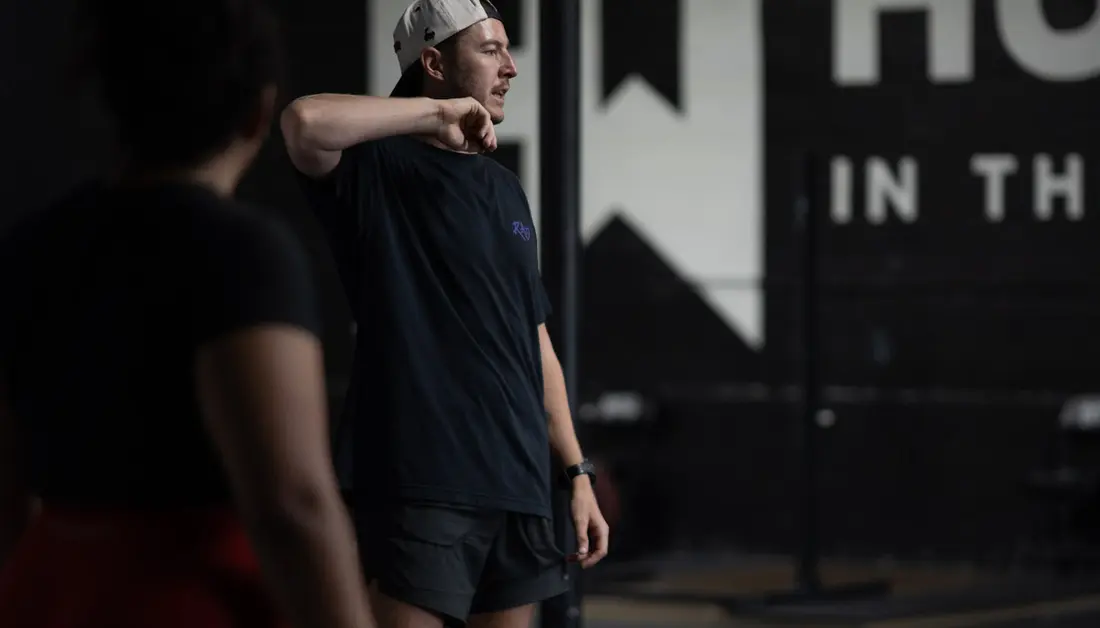
A first block at Hunger in the Wild starts with an assessment, not a workout. We find out what you can actually load, where your positions break down, and what your week realistically allows. Then we build backward from there.
Programming runs in periodized blocks through TeamBuildr, so we write down your lifts and loads before you walk in, and your progress is visible across weeks rather than guessed at. Sessions are capped small enough that a coach is correcting reps as they happen, which is the part no app replicates. Each session has one primary lift that drives the block, accessory work chosen for a reason rather than for variety, and a planned response for the week your numbers stop moving.
Nobody here has to justify being a beginner. The room is full of people who were new at some point and stayed.
Not sure whether to start one-on-one or in a small group. See how group classes run.
Six months is too long to run on feel. Four things are worth writing down, and none take more than a minute per session.
If those four are moving, the program is fine. If they’re flat for three weeks, something specific is wrong, and the log will usually tell you which one.
What you’re comparing | Coached first block | Program off the internet |
Lift selection | Chosen after seeing you move | Chosen before anyone has seen you move |
How load goes up | Adjusted to the quality of last week’s sets | Fixed increment regardless of how the sets looked |
Technique correction | During the set, while it still counts | From a video you film and review later, if at all |
What happens at a plateau | Planned deload or rep-range change | You go looking for a different program |
Tracking | Written down and reviewed by someone else | Whatever you remember |
Time to a real PR | Measured in blocks | Measured in restarts |
Six months is long enough to build something you keep and short enough to waste entirely. The difference between those two outcomes is rarely effort. It’s whether the load went up on purpose and whether anyone was watching the reps while it did. Hunger in the Wild has been coaching that first block since 2016 under founder Kyle Dosterschill, a former top-ranked USA Olympic weightlifter and USAW Level-2 National Coach, alongside Director of Programming Ash Morris-Williams and senior coach Jessica Dosterschill.
Everyone on that floor who looks like they’ve always lifted has mostly just logged two boring years.
A free consultation covers a facility tour, a look at how you move, and an honest read on what your first six months should contain.
Start with a conversation, not a contract. Book a free consultation and facility tour.