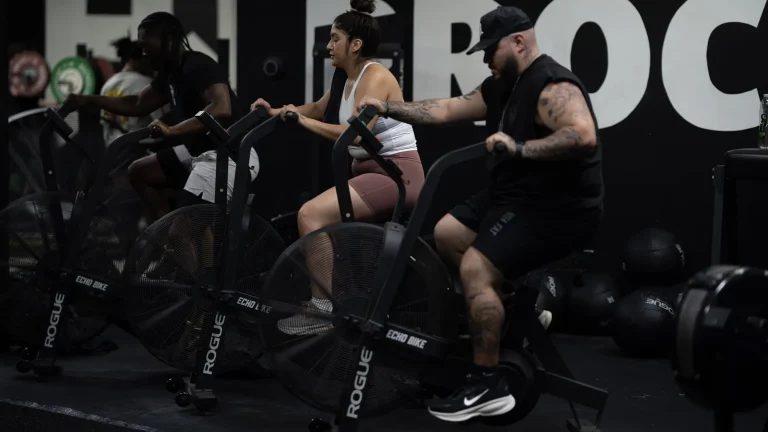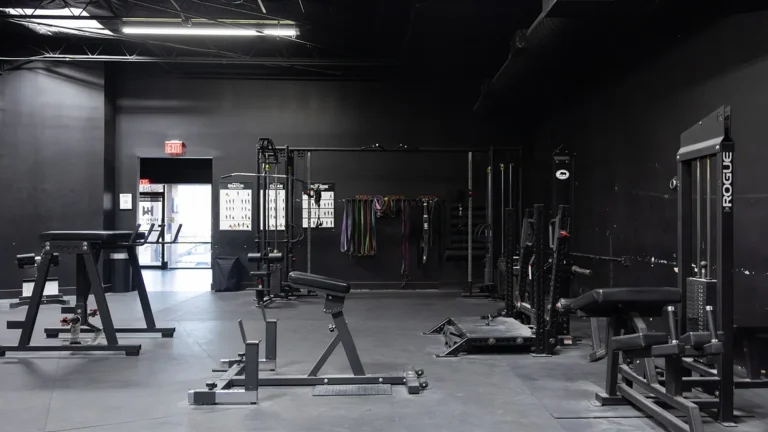
Walk into most gyms and you will see the same thing: a class that starts with a barbell movement, rushes through a few heavy sets with minimal rest, then transitions into a conditioning circuit — all crammed into 45 to 60 minutes. The members are sweating, breathing hard, and feeling like they got a great workout.
But here is the problem: they are not getting stronger. They are getting tired.
At Hunger in the Wild Gym, we separate our training into dedicated domains — strength, conditioning, Olympic weightlifting, and HYROX — each with its own class, its own programming, and its own purpose. Our strength sessions do not include conditioning. Our conditioning sessions do not include heavy barbell work. And there is a reason for that rooted in decades of exercise science.
This is not an opinion. This is how the body actually adapts.
Lifters who want dedicated strength work without conditioning cutting into recovery or performance can train with focused programming through Hunger In The Wild’s Coach-led Strength Training Classes in Dallas.
When you combine heavy strength work and high-intensity conditioning in the same session, you are asking your body to do two contradictory things at the same time. The research calls this the interference effect, and it has been studied extensively since Dr. Robert Hickson first identified it in 1980.
Here is what happens at the physiological level. Strength training activates a signaling pathway called mTOR, which drives muscle protein synthesis — the process your body uses to build and repair muscle tissue. Conditioning and endurance work activate a competing pathway called AMPK, which prioritizes aerobic adaptation and energy efficiency. When both pathways are activated simultaneously or in close succession, the AMPK signal can suppress the mTOR response. Your body receives a mixed message, and the strength adaptation gets blunted.
A 2012 meta-analysis published in the Journal of Strength and Conditioning Research examined 21 studies and found that concurrent strength and endurance training resulted in significantly reduced gains in strength, power, and muscle size compared to strength training performed alone. The interference was most pronounced when running was the conditioning modality and when training frequency and duration of the endurance component were high — which describes exactly what happens when you mix heavy lifting and conditioning circuits in the same class, multiple days per week.
A more recent 2024 review in Frontiers in Sports and Active Living reinforced these findings and added an important nuance: the interference effect is amplified when the recovery interval between the two training modes is short. In a mixed-modality class where you go straight from barbell work into a conditioning circuit with little to no transition, that recovery interval is essentially zero.
This does not mean conditioning is bad. It means combining it with strength work in the same session compromises both.
One of the clearest indicators that a gym does not understand strength training is how it handles rest between sets. If your program has you resting 30 to 60 seconds between heavy compound lifts, or worse, supersetting strength movements with conditioning work to “stay busy,” the programming is prioritizing the feeling of a hard workout over the actual outcome of getting stronger.
The research on rest periods is clear. A landmark 2016 study by Schoenfeld et al. in the Journal of Strength and Conditioning Research found that 3-minute rest periods produced significantly greater increases in both muscle strength and muscle size compared to 1-minute rest periods in resistance-trained men, even when total training volume was equated.
Why? Because adequate rest allows your ATP and creatine phosphate stores to replenish — the energy systems that fuel high-force, short-duration muscular contractions. When you cut rest short, you cannot produce the same force output on subsequent sets. You end up lifting less weight for fewer quality reps, which means less mechanical tension on the muscle, which means less adaptation.
For maximal strength development, the evidence supports 2 to 5 minutes of rest between heavy compound sets. For hypertrophy, 1 to 2 minutes appears to be the sweet spot when training with moderate loads. Neither of these protocols is compatible with a format that demands constant movement and minimal downtime.
In our strength classes at Hunger in the Wild, rest periods are prescribed and intentional. They are part of the program, not dead time to be eliminated. When you rest 3 minutes between sets of heavy back squats, you are not being lazy — you are allowing your nervous system and energy systems to recover so that your next set is actually productive. That is how strength is built.
Progressive overload — the systematic increase of training demand over time — is the foundational principle of getting stronger. Without it, your body has no reason to adapt. And progressive overload requires two things that mixed-modality programming almost always lacks: consistency in exercise selection and accurate tracking of loads.
When your program changes constantly — different exercises every day, different rep schemes, different combinations of movements — you never stay with any single lift long enough to develop proficiency or track meaningful progression. You might back squat on Monday, front squat on Wednesday, and do air squats in a circuit on Friday. Each of those movements loads the body differently, and switching between them constantly prevents you from isolating the variable that actually drives strength: progressive increases in load on the same movement pattern over weeks and months.
In a dedicated strength program, you perform the same core lifts repeatedly across a training block. You know exactly what weight you used last week, how many reps you completed, and what the target is this week. You can measure whether you are improving because the conditions are controlled. That is what periodization looks like in practice — structured progression through intentional phases of training, not random variation disguised as programming.
There is a pervasive belief in fitness culture that a workout is only effective if you are destroyed by the end of it. Lying on the floor, gasping for air, unable to move — that is the benchmark of a “good session.”
This is exactly backwards for strength development.
Fatigue is a byproduct of training. It is not the goal. The goal is adaptation — a measurable improvement in your body’s ability to produce force. And the quality of the stimulus you provide during training determines the quality of the adaptation you receive.
When you are pre-fatigued from a conditioning circuit and then attempt heavy barbell work, or when you rush through heavy sets to get to the metabolic finisher, you are degrading the quality of every rep. Your technique deteriorates. Your force output drops. Your injury risk increases. And the training stimulus you are sending to your muscles and nervous system is diluted.
In a dedicated strength session, every set is performed with the intent to move the weight as well as possible — controlled tempo, proper bracing, full range of motion, and maximal effort on each rep. The session is designed so that you can bring your best to every working set, not just survive until the clock runs out.
If you are training for HYROX, you might think this argument does not apply to you. After all, HYROX mixes running and functional stations — is that not the same as mixing strength and conditioning?
No. And this distinction is critical.
HYROX is a race. It is the event you are training for, not the way you should train every day. The best HYROX athletes do not prepare by doing a watered-down version of the race five days a week. They build each physical quality separately — strength in dedicated strength sessions, aerobic capacity in dedicated engine sessions, station technique in dedicated practice — and then bring those qualities together strategically during race simulations as they get closer to competition.
Your strength training directly improves your HYROX performance. A stronger squat means more powerful sled pushes. Stronger posterior chain means faster sled pulls and more efficient lunges. Better grip strength means unbroken farmer carries. But you only build that strength in an environment that allows for proper loading, adequate rest, and progressive overload — not in a circuit where you are bouncing between movements with your heart rate at 85 percent.
This is exactly why Hunger in the Wild programs strength and HYROX training as separate classes. The strength session builds the raw capacity. The HYROX session teaches you how to deploy that capacity under race conditions. One feeds the other. Neither replaces the other.
At Hunger in the Wild, our strength classes follow a periodized program managed through TeamBuildr. Here is what that means in practice:
Planned training blocks. Each block runs 4 to 6 weeks with a specific focus — accumulation, intensification, or realization. Volume and intensity progress systematically across the block, and a programmed deload allows for recovery before the next phase begins.
Consistent exercise selection. You will perform the same core movements across a training block so you can track progression and build technical proficiency. Variations rotate between blocks, not between days.
Prescribed rest periods. Rest is part of the program, not an afterthought. Heavy compound work gets 2 to 4 minutes. Accessory work gets 60 to 90 seconds. This is based on what the research says optimizes strength and hypertrophy, not on what makes the class feel more intense.
Coached every session. A qualified coach is on the floor every class providing real-time feedback on technique, load selection, and effort. You are not just following a whiteboard — you are being coached through every working set.
No conditioning mixed in. If you want conditioning, we have dedicated engine classes for that. If you want to train for HYROX, we have HYROX classes. The strength session is for getting strong. That is all it needs to do, and it does it exceptionally well.
Separating your training into dedicated sessions does not mean you pick one goal and ignore everything else. It means you give each goal its own slot in the week so that every session is productive and nothing gets diluted.
A well-structured training week might look like this:
Monday and Tuesday — Strength. Heavy compound lifts with full rest periods, progressive overload, and coached technique. You walk out stronger than you walked in.
Thursday — Engine/Conditioning. Dedicated aerobic and anaerobic work — intervals, rowing, running, ski erg — programmed with specific intensity targets. Your cardiovascular system gets the focused stimulus it needs without cutting into your strength gains.
Wednesday and Saturday — HYROX. Station-specific practice, compromised running, and race simulation work. This is where your strength and conditioning come together under race-like conditions.
Saturday — Olympic Weightlifting or Accessory Work. Technical skill development in a low-fatigue environment with qualified coaching.
This is not a hypothetical schedule. This is how our members actually train at Hunger in the Wild. They get stronger, better conditioned, and more prepared for competition — not because they do everything at once, but because each session has a clear purpose and the programming across the week is coordinated.
The person training this way for six months will be measurably stronger, better conditioned, and more technically proficient than the person who spent six months doing a different mixed workout every day. Not because they worked harder. Because their training was smarter.
You can see our full weekly schedule and find the right combination for your goals here: HITW Class Schedule.
Mixing heavy strength work with conditioning in the same session is not a more efficient use of your time. It is a less effective use of your training. The interference effect is real. Rest periods matter. Progressive overload requires consistency. And fatigue is not a substitute for adaptation.
If your goal is to get genuinely strong — not just tired — your strength training needs its own dedicated session with its own programming, its own rest protocols, and its own coaching.
That is how we train at Hunger in the Wild. Not because it is trendy. Because the science says it works, and 20 years of coaching results confirm it.
If you are in Dallas and want to experience what strength training is supposed to feel like, book a free consultation and come see the gym. We will walk you through our programming, introduce you to the coaching staff, and help you find the right starting point.
Ready to train with purpose?
Book a Free Consultation | View Strength Classes | Explore All Classes