
The HYROX average time depends on your division. Kracey’s analysis of 2025/26 results reports 1:31 for Open Men and 1:40 for Open Women as arithmetic means. For the finisher in the middle of the pack, RoxHype’s 2025/26 analysis gives medians of 1:27:49 and 1:36:08. These are independent analyses of public race results. They aren’t official averages published by HYROX, and they aren’t a prediction of your first race.
That last part matters. If you’ve spent years getting strong and you’re now building an engine, a finish-time table can help you pick a target. It can also convince you that you’re behind before you’ve even raced.
You’re not racing an internet average. You’re racing eight runs, eight stations and the decisions you make between them. Here’s how to use the numbers without letting them write a race plan your training can’t back up.
The mean, or arithmetic average, adds up every finish time and divides by the number of results. The median is the middle result: roughly half the field finishes faster and half finishes slower.
A long tail of slower finishes can pull the mean above the median. That’s why the Open Men figures above don’t contradict each other. One describes the average of the whole sample. The other describes its middle.
HYROX’s own preparation page gives a broad average of 90 minutes, but it doesn’t say which season, divisions, sample or calculation that number comes from. It’s useful orientation, not a current statistical table by division.
A Rox Lyfe guide using earlier RoxFit data lists Open averages of 1:27:56 for men and 1:36:22 for women, and warns that its figures are historical reference points. It doesn’t say whether those values are means or medians. Across the datasets here that are clearly labeled as medians, the middle of the Open field sits at roughly 87 to 88 minutes for men and about 96 minutes for women. The reported arithmetic means are slower. Don’t blend these sources into one falsely precise average.
For benchmarking, start with your division’s median. For a personal goal, start with your own training. Neither number knows whether you’re a first-timer, a lifelong runner or a strong lifter still learning to run after lunges.
Data note: Kracey says its figures cover 97 events in 2025/26 and rounds its means to the nearest minute. RoxHype labels its dataset as 709,816 finishes from 2025/26 and reports medians and percentile cutoffs to the second. The two count and cover results differently. We checked the published tables; we didn’t rebuild either dataset from every official result. Treat the figures below as reference points, not universal standards.
All times below are hours:minutes:seconds, except the rounded mean column, which is hours:minutes. Doubles rows are elapsed team finish times, not one athlete’s work time.
| Division | Reported mean, Kracey (h:mm) | Median, RoxHype (h:mm:ss) | Fastest-10% cutoff, RoxHype (h:mm:ss) |
|---|---|---|---|
| Open Men | 1:31 | 1:27:49 | 1:10:11 |
| Open Women | 1:40 | 1:36:08 | 1:18:08 |
| Pro Men | 1:24 | 1:20:50 | 1:05:50 |
| Pro Women | 1:30 | 1:26:40 | 1:11:04 |
| Men’s Doubles | 1:19 | 1:16:16 | 1:03:40 |
| Women’s Doubles | 1:31 | 1:28:16 | 1:14:34 |
| Mixed Doubles | 1:26 | 1:23:06 | 1:08:26 |
Sources: Kracey, updated October 3, 2026, and RoxHype, 2025/26 benchmark tables, both checked November 10, 2026. A fastest-10% cutoff is the boundary for the fastest tenth of that sample, not their average time. The two sources are separate datasets, so don’t use these columns to calculate an exact mean-to-median gap within one population.
The fields are different. The athletes who choose Pro aren’t a random sample of Open athletes handed heavier equipment.
So don’t knock a few minutes off an Open goal because the Pro median looks faster. Match the benchmark to the division you actually entered, and check the HYROX weights by division before you decide whether your station estimates are realistic.
Sharing the station work helps, but both partners still run the full 8 km together. You can’t budget the runs around the faster partner’s solo pace and hope the other athlete keeps up.
Use the doubles row that matches your pairing, then build a team estimate. If you’re still choosing a format, see HYROX doubles vs. singles. For legal work-sharing and partner requirements, use our HYROX doubles rules guide.
Be extra careful with relay data. RoxHype reports 2025/26 medians of 1:27:28 for Men’s Relay, 1:38:46 for Women’s Relay and 1:33:13 for Mixed Relay. Its listed samples are only 187, 167 and 267 finisher entries, and it says each athlete counts as a finisher in team divisions, rather than each entry counting as one team.
A separate Hybrid Huddle dataset, covering nine seasons, reports much faster relay medians: 1:16:01, 1:29:52 and 1:23:00. These samples aren’t interchangeable, and neither page gives enough matching coverage detail to explain the full gap, so we wouldn’t use either one as a universal relay target. Compare your team with recent official results for the same relay category and event instead.
A good time needs a comparison group. In the RoxHype sample, an Open Woman who finishes in 90 minutes is faster than the median. An Open Man who finishes in 90 minutes is slower than the median. Same clock, different context.
The fastest-10% cutoffs are also a long way ahead of the middle of the field. Holding them up as what a normal first-timer “should” do isn’t useful coaching.
Here’s how we frame experience levels at HITW. These are coaching priorities, not official HYROX classifications or measured beginner averages.
| Athlete stage | A useful definition of a good race | What to measure next |
|---|---|---|
| First race / beginner | Complete the required work legally, manage effort and learn your real splits | Where planned time and actual time differed |
| Developing / intermediate | Beat your own comparable result with fewer breakdowns | Your largest repeatable source of lost time |
| Experienced / advanced | Chase a division-and-age-specific placement or percentile | The gap to that specific field, not a universal label |
There’s no beginner-only dataset behind this article, so we’re not going to call an all-ages Open median a first-race average.
If your first result is slower than the median, you still have a useful starting point. If you beat it, great. Either way, the work you can repeat next month matters more than the label you give yourself today.
Age-group context is more useful than comparing yourself with the fastest person on social media. Here are selected Open division medians from RoxHype’s 2025/26 tables:
| Age group | Open Men median | Open Women median |
|---|---|---|
| 16–24 | 1:26:01 | 1:35:55 |
| 25–29 | 1:25:19 | 1:34:26 |
| 30–34 | 1:25:50 | 1:34:55 |
| 35–39 | 1:27:23 | 1:36:08 |
| 40–44 | 1:29:17 | 1:36:53 |
| 45–49 | 1:31:06 | 1:38:29 |
| 50–54 | 1:34:28 | 1:40:30 |
| 55–59 | 1:38:35 | 1:45:26 |
| 60–64 | 1:40:52 | 1:45:47 |
Source: RoxHype, Open age-group tables, checked November 10, 2026. These are observed results, not an age-adjustment formula. Sample sizes shrink in the older brackets: the source lists 1,793 men and 763 women at ages 60 to 64, compared with 32,960 men and 22,300 women at ages 25 to 29.
Two 44-year-olds, one who has trained endurance for years and one coming back to running, don’t need the same target. Age gives you context. Your training history, current capacity and race execution still decide what you can reasonably ask of yourself.
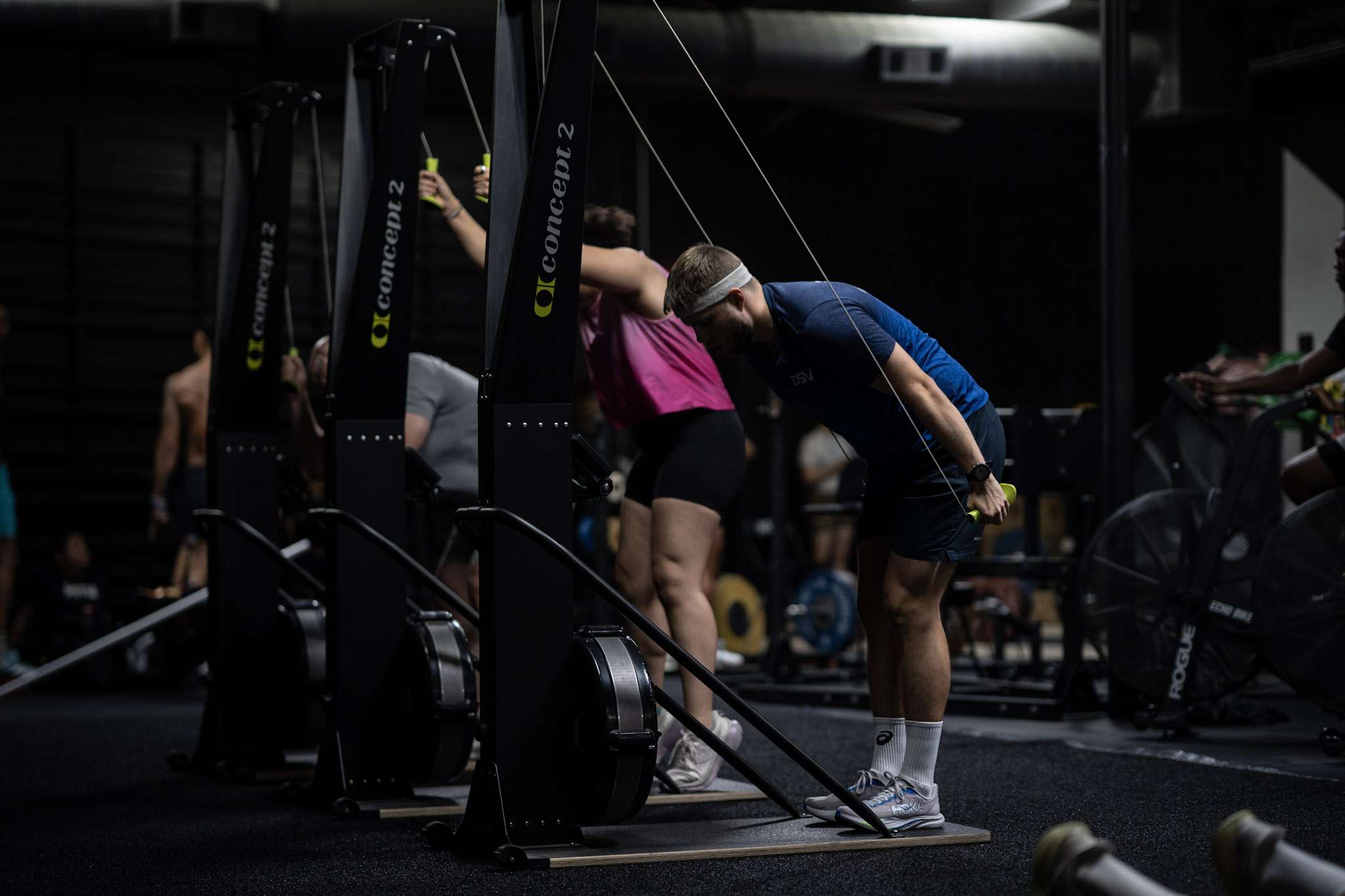
Think of your time in three buckets:
Don’t add a fast fresh run to your best-ever isolated station times and call it a prediction. Those efforts didn’t happen back to back.
The two athletes below are fictional coaching examples, not HITW members or recorded results. Every split is hypothetical and chosen to show the arithmetic.
Marcus is comfortable moving weight. Running after sled work is newer territory for him.
His starting budget is 52 minutes running + 40 minutes at stations + 8 minutes in the Roxzone = 1:40:00. That running estimate means averaging 6:30 per kilometre across all eight runs, not running the first kilometre at that pace and hoping the rest take care of themselves.
Say his training suggests he can bring his total running down to 48 minutes, with the other buckets unchanged. That gives 1:36:00, four minutes faster. He doesn’t need to turn every erg into a sprint for that math to work.
That’s a hypothetical improvement, not a promise. The point is to find the largest gap he can train before adding more of what he’s already good at.
Elena runs steadily, but her station estimates include long breaks once she’s tired.
Her hypothetical budget is 44 minutes running + 42 minutes at stations + 8 minutes in the Roxzone = 1:34:00. If repeatable technique and manageable sets bring her stations down to 38 minutes, with the other buckets unchanged, her revised total is 1:30:00.
For Elena, squeezing another minute out of fresh running may not be the best first move. She needs to know which station is causing the stops, and whether the runs before it are making that problem worse.
Neither example tells you to race those splits. For a run-by-run and station-effort plan, use our HYROX pacing strategy. This page helps you choose a total you can defend. That guide helps you spread the effort across the race.
You don’t need a fancy HYROX time calculator for a useful first estimate. You do need honest inputs.
Pick singles, doubles or relay, then your division. Use the correct loads, movement standards and work-sharing rules. A station time at a lighter load isn’t a race-load estimate.
Look at recent training that combines running and stations at a controlled effort. For a first estimate, use a pace you can repeat after station work, not your fresh 5 km best.
Time your station breaks too. The clock doesn’t stop while you decide whether you can pick the sandbag up again.
Use a previous comparable race if you have one. If you don’t, leave the uncertainty visible instead of assuming zero. Our examples use eight minutes only to show a complete budget. That isn’t a standard Roxzone allowance or a prediction for Dallas.
Using Marcus’s hypothetical 100-minute budget, a coach might talk about a 95 to 105 minute planning range. That range is an illustrative coaching choice, not a statistical confidence interval. Your training should decide whether it needs to be wider or narrower.
Keep a process goal alongside it: legal reps, deliberate transitions and an effort you can hold through the final station. A target should guide your decisions, not talk you into ignoring the race in front of you.
A repeatable session, a better feel for race-load stations or a previous result can all sharpen the estimate. One great workout doesn’t automatically justify a much faster target.
For the bigger training picture, read how to prepare for a HYROX race. For logistics and how the day flows, see what to expect at your first HYROX race.
For your next training block, not a last-minute race-week overhaul, keep the focus simple:
This is HITW coaching guidance, not an individualized program. Build volume around your current training and recovery. More fatigue isn’t automatically more preparation.
HYROX Dallas runs November 18 to 22, 2026. If that’s your race, the final few days before the start aren’t the time to build a new engine.
Use these benchmarks to settle on a realistic expectation, not to panic-train toward someone else’s number. Keep race week about arriving ready and doing what you’ve practiced. Our final-weeks HYROX Dallas guide covers that stretch.
At Hunger in the Wild Gym, an official HYROX Training Club in Dallas, we help athletes connect strength, running and station skill instead of treating them as separate workouts. Owner and founder Kyle Dosterschill is a USAW Level 2 National Coach.
Explore HYROX classes in Dallas or book a free consultation to talk through your starting point and your next training block. Training somewhere else? See our online programs or start with the free HYROX program.
As of November 10, 2026, Rox Lyfe’s record tracker lists Alexander Roncevic’s 51:59 and Joanna Wietrzyk’s 54:25 as the Pro singles world records. Both came at the Warsaw Major on April 16, 2026.
Those are extraordinary performances by elite Pro athletes. They aren’t the average, and you don’t need to come anywhere near them to belong in the sport. Records also change. We’re reporting the tracker’s listed marks, not claiming to have audited every official result since.
A good HYROX time is one you can explain with your preparation and race with control. Start there, then build the capacity to move the number.
Kracey’s analysis of 2025/26 results reports arithmetic means of 1:31 for Open Men and 1:40 for Open Women. RoxHype reports medians of 1:27:49 and 1:36:08. These are independent analyses of public results, not official HYROX averages.
There is no verified beginner-only average in the sources used here. HITW coaching guidance is to set your first goal from repeatable running and station efforts, include Roxzone time, and prioritize a legal finish you can sustain rather than chase a universal cutoff.
In RoxHype’s 2025/26 sample, 90 minutes is slower than the Open Men median of 1:27:49 but faster than the Open Women median of 1:36:08. The same finish means different things by division and age; neither comparison measures your personal progress.
RoxHype’s Open medians at ages 25–29 are 1:25:19 for men and 1:34:26 for women. At ages 40–44 they are 1:29:17 and 1:36:53; at ages 55–59 they are 1:38:35 and 1:45:26. These are sample medians, not age-based predictions.
Kracey reports 2025/26 mean team times of 1:19 for Men’s Doubles, 1:31 for Women’s Doubles and 1:26 for Mixed Doubles. RoxHype’s corresponding medians are 1:16:16, 1:28:16 and 1:23:06. Both partners still run the full 8 km; they share station work.
Pro attracts a different field of athletes, so its faster median does not mean heavier weights make the race easier. RoxHype reports 2025/26 medians of 1:20:50 for Pro Men and 1:26:40 for Pro Women. Compare within your division rather than treating Pro as a fixed adjustment to an Open time.
Add your estimated total for all eight runs, all eight stations and the Roxzone. Use running efforts performed after station work, include station breaks, and allow a realistic uncertainty range. A calculator is only as useful as those inputs.
Rox Lyfe’s record tracker, checked November 10, 2026, lists Pro singles records of 51:59 by Alexander Roncevic and 54:25 by Joanna Wietrzyk, both at the Warsaw Major on April 16, 2026. Records change, and these elite performances are not beginner benchmarks.