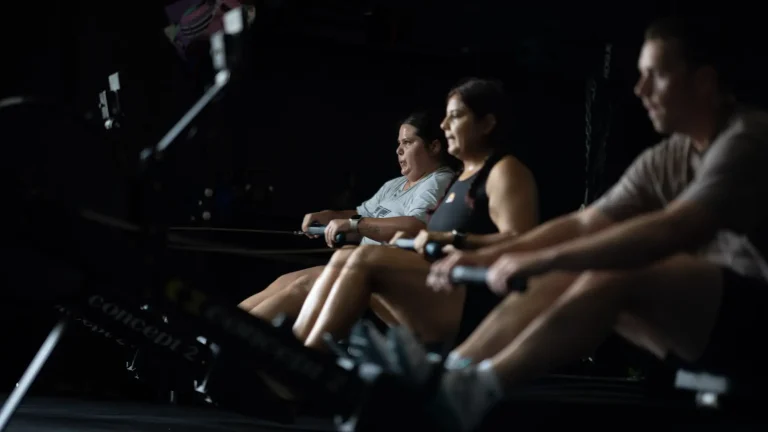


HYROX doubles rules are straightforward: both partners run all eight 1km segments together, then share the work at eight stations, with one athlete working at a time. Station splits don’t have to be equal. Mixed Doubles partners use the same station loads, but each throws wall balls to their own target height. Stay together, make legal handoffs and finish every station before you move on.
The details are where first-time teams get nervous. Can your partner handle the rope while you pull? Can you pass a wall ball in the air? Does the stronger athlete have to do exactly half?
I put together a Mixed Doubles guide for two clients getting ready for their first race. This guide to HYROX Mixed Doubles rules takes those questions further than a rules sheet does: what the rules mean, what to decide with your partner ahead of time, and what not to make up on the spot when you’re tired.
To keep it concrete, we’ll use Alex and Sam, a made-up first-time mixed pair, as an example. Alex is more comfortable on the sleds. Sam is more comfortable running. Neither one needs to prove anything by doing half of every station.
Rules reference: This guide follows the official HYROX Season 26/27 Doubles Rulebook. Check the official rulebook page and your event briefing for updates. The coaching suggestions below are options, not extra competition rules.
A run comes before every station below. Distances and reps are the team’s total station work, not an amount each person repeats.
| Order | Station | Mixed Doubles work and load | Practical split idea (not a rule) |
|---|---|---|---|
| 1 | SkiErg | 1,000m; damper preset 6 | Use repeatable blocks; release the handles instead of passing them |
| 2 | Sled push | 50m: four 12.5m lengths; 152kg including sled | Assign lengths, with more work to the stronger pusher if useful |
| 3 | Sled pull | 50m: four 12.5m lengths; 103kg including sled | Plan your changes; the resting partner can’t manage the rope |
| 4 | Burpee broad jumps | 80m; no external load | Short, repeatable turns; incoming hands line up with outgoing toes |
| 5 | Rowing | 1,000m; damper preset 6; footplates preset 4 | Planned turns; the rulebook gives a swap after 250m as an example |
| 6 | Farmers carry | 200m with two 24kg kettlebells | Change before your grip fails; never move the bells forward during a handoff |
| 7 | Sandbag lunges | 100m with a 20kg sandbag | Repeatable turns; pass the bag sideways or backward, not forward |
| 8 | Wall balls | 100 valid reps with a 6kg ball; men 3.00m, women 2.70m | Planned sets; hand over the ball or let it go to the floor |
These are Mixed Doubles loads. Don’t apply this table to Women’s Doubles or Men’s Pro Doubles. For HYROX doubles weights in other divisions, use our HYROX weights by division guide.
The detail that matters most for mixed pairs: both athletes use the 6kg wall ball. The target height changes with the athlete throwing; the ball weight doesn’t.
Yes. Each partner runs the full 8km. You can’t send one person out while the other rests at the next station. Doubles shares the station work, not the running.
The official rulebook says partners must run together for the entire segment. Running ahead costs a one-minute penalty, and more than three penalties for not staying together means Out of Competition, with no ranking.
Alex and Sam’s plan is simple. Sam doesn’t run at Sam’s solo pace and then wait at the arch. They pick a pace both of them can hold, and they agree on a word that means “ease off” before a gap opens.
Not sure doubles is the right format for you? Our doubles vs singles guide covers that decision. This post is about racing doubles legally once you’ve chosen it.
Yes. Both partners enter together, the work can’t start until both of you are there, and you both leave together once the required work is done.
Don’t sprint ahead to claim equipment or start the monitor while your partner finishes the run. Follow the judge’s equipment assignment and use the correct entry and exit routes. Going through the wrong Roxzone IN or OUT arch costs a two-minute penalty per infringement, and entry and exit errors at the workout stations carry penalties too.
The resting athlete stays on their feet, inside the designated workout zone, without blocking anyone. No sitting, kneeling or dropping to the floor to recover.
Resting also doesn’t mean doing whatever helps. On the sled pull, you can’t manage your partner’s rope with your hands or feet. On the ergs, you can’t pass the handles to each other. On the rower, you can’t adjust your partner’s straps or damper.
Your job between turns is to recover, listen and be ready. Don’t invent an extra role.
No. HYROX penalties vary by infringement. For movement standard faults at stations 1 to 7, the rulebook describes one warning per station, then the penalty on the second infringement, whatever the fault. Many station rules set 15 seconds for each infringement after the warning.
That isn’t a free warning for every possible mistake. Some violations carry immediate or different penalties. Sandbag unloading, returning equipment incorrectly, wrong weights and incomplete stations all have their own rules. At wall balls there are no warnings at all: a rep is valid or it isn’t.
| Mistake | Consequence under the official rulebook |
|---|---|
| One partner runs ahead | One-minute penalty |
| More than three togetherness penalties | Out of Competition; no ranking |
| Wrong Roxzone IN or OUT arch | Two minutes per infringement |
| Kettlebells not returned correctly or upright | 30 seconds; waived if corrected before leaving the Roxzone |
| Sandbag not returned to its marked area | 30 seconds; waived if corrected before leaving the Roxzone |
| Sandbag unloaded onto a surface during lunges | 15 seconds per infringement |
| Invalid wall ball | No-rep: it doesn’t count |
| Incomplete station or missed entire 1km run | Disqualification under the incomplete station and run rules |
Wrong weights on the carry or the lunges are especially costly. The station rules require you to repeat the whole station at the correct weight, and not doing it means disqualification. Don’t assume you can take a small time penalty and keep going.
Not for use during the race. Only event-provided chalk and chalk accessories can be used, at the designated sled pull and farmers carry stations. Don’t take that chalk to another station or carry your own around the course. Chalk infringements carry a two-minute penalty, and so does powdered chalk at wall balls.
Some media coverage mentions chalking up before the start, but the official documents don’t establish that exception. Don’t treat a social media summary as permission to bring your own chalk onto the course.
Missing part of a run and skipping a whole run aren’t the same thing. The penalty table lists three, five or seven minutes for a missed lap on four-, three- or two-lap layouts, and disqualification on a one-lap layout. Missing an entire 1km run means disqualification.
Know your event’s actual layout. Don’t borrow a lap count from a video filmed in another city.
Our complete HYROX stations guide covers the movements in general. Here the focus is what changes when someone else is sharing the work.
No. Release the handles and let the next athlete take them. The resting partner stays in the marked area. Only the working athlete can change the damper; 6 is the preset, not a setting you have to keep.
Keep your feet over the baseplate, not the floor. A dynamic or jumping SkiErg motion is allowed, but both feet must land back on the baseplate. When you finish, stay on the platform, raise an arm and wait for the judge to confirm.
For Alex and Sam, two controlled blocks may be simpler than lots of short swaps. If one person’s rhythm starts to break down, smaller blocks are an option. Make that call before technique falls apart.
Alternating full lengths is a useful starting plan, not a requirement. The entire sled has to cross the line before you turn, and the resting partner walks right behind the working athlete without getting in another lane’s way.
If Alex pushes more smoothly, Alex can take more of the work. But a heroic sled effort that leaves Alex unable to run with Sam isn’t automatically a good trade. The next kilometer still belongs to both of you.
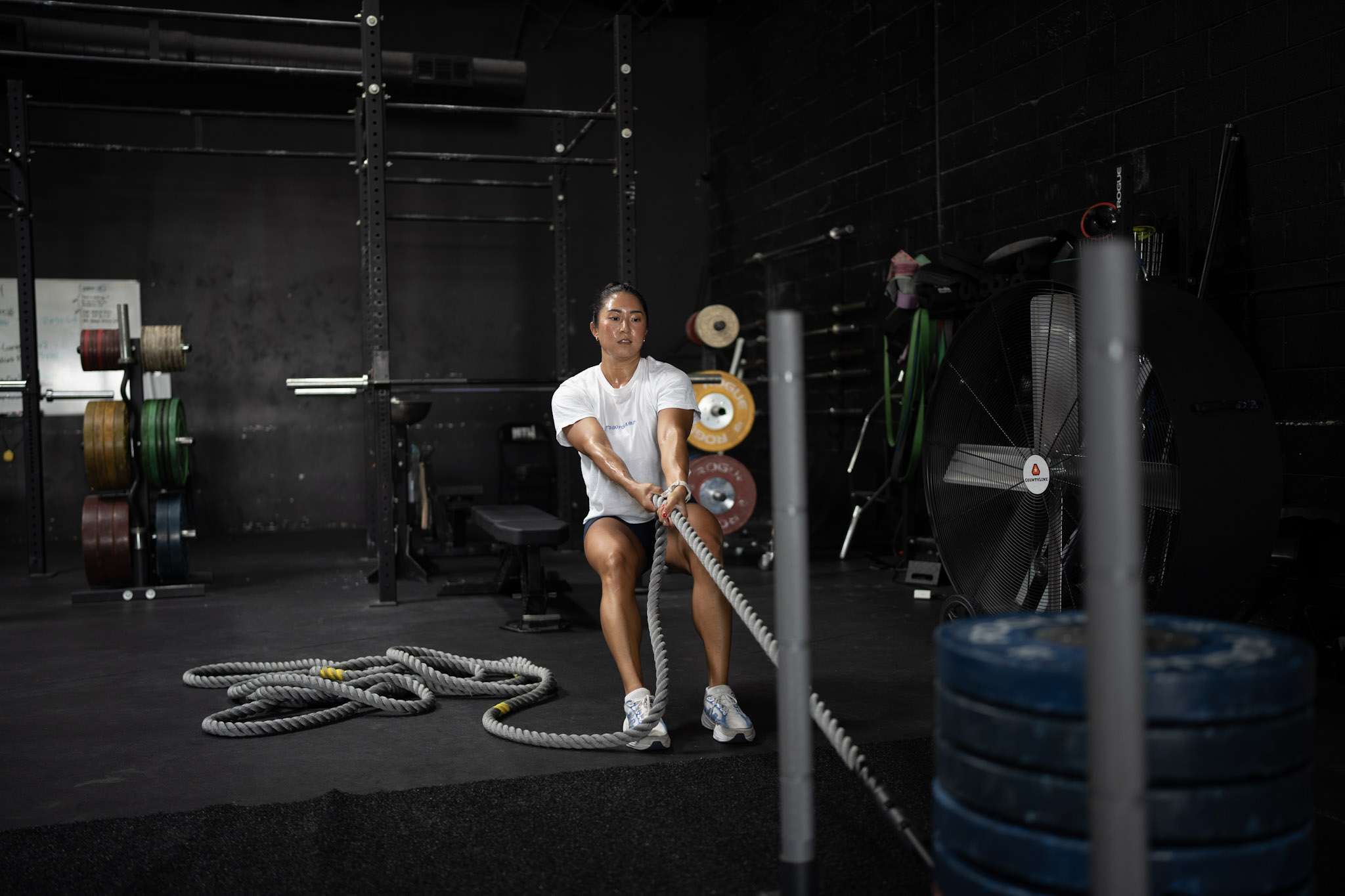
No. The resting partner stays behind and can’t help manage the rope. The working athlete stays standing and inside the Racers Box, off its front and back lines while holding the rope.
Finish each length fully before changing direction. Keep the rope in your lane and clear of the athletes next to you. Agree on who starts, where you’ll swap and one useful cue. Two people shouting different instructions doesn’t make the sled any lighter.
The incoming athlete puts their hands where the outgoing partner’s feet landed, with toes and fingers in line. That’s the handoff. No stepping forward before you start.
Chest touches the ground. Both feet take off and land together, with no more than the permitted 5cm stagger and no extra shuffle steps. The resting athlete follows behind, not alongside.
Pick turns you can repeat. Sam might move well here, but that doesn’t mean Sam should keep going until the next run turns into a walk. Swap while the movement still looks like the one you practiced.
The damper starts at 6 and the footplates at position 4. Athletes can use their own preferred settings within the rules, but only the working athlete adjusts the damper. Partners can’t pass the handle or adjust each other’s straps. The resting athlete waits in the marked area behind the rower.
You can split the 1,000m row between you; the rulebook gives a swap after 250m as an example. Return the handle to its holder instead of passing it, and have the incoming athlete set their own straps and damper. When the station is done, wait for the judge to confirm before you leave.
A complicated changeover can wipe out the benefit of a short turn, so rehearse your swap before race day.
No. Handoffs go sideways or backward, never forward. The working athlete carries both bells with arms extended at their sides, and the resting partner follows behind.
You can put the bells down to rest, but you can’t gain ground while setting them down. Plan your changes before the handles start slipping, not after. When you finish, return both bells to the correct box with the handles upright.

Don’t use the floor or any other surface to unload the bag. While you’re lunging, it stays fully supported across both shoulders, and handoffs can’t move the bag forward.
Every alternating lunge needs a clear trailing-knee touch and a full standing finish. No walking or shuffling forward between reps. Cross each required line correctly, and return the sandbag to its marked area when you’re done.
For Alex and Sam, the right turn length is one they can repeat with clean knee touches and full extension. Agree on a shorter backup turn in case technique starts to slip.

Not as a continuous “flying” changeover. You can hand the ball to your partner or let it go to the floor. The incoming athlete starts standing tall with the ball before beginning the squat.
Hips go below the knees, and the ball has to hit the correct target. The resting athlete stays in the marked area underneath the rig. Standing outside that area can mean no-reps for as long as the infringement continues.
One possible split is 10 reps each, five times through, for 100 total. Another option is 15 and 5 reps, five times through. Neither is a prescription. Choose based on the valid reps you can actually deliver when you’re tired, and listen to the judge’s count.
No. You can split the station work unevenly. Equal suffering isn’t a competition requirement.
Alex and Sam should write down three decisions for every station: who starts, how big each turn is, and the backup plan. “We’ll figure it out” isn’t a backup plan.
The backup can be simple: shorter wall ball sets if depth slips, earlier carry changes if grip fades, or a different sled split if one partner is struggling. Keep the change legal and say it out loud before you stop.
Don’t give every strength station to the same athlete without thinking about the run after it. The goal is a team that works across the whole race, not winning your favorite station and losing your partner on the way out.
This is a checklist for agreeing as a team, not a packing list:
Racing HYROX Dallas, November 18 to 22, 2026? Check the official event page for the final running lap count before race day; this post isn’t the event briefing. For your taper and final weeks, use our HYROX Dallas final-weeks guide.
FREE 4-WEEK HYROX PROGRAM
Four training days a week, every HYROX station at race distance, and a benchmark in Week 1 with a retest in Week 4.
Get the free programONLINE HYROX TRAINING
Open the HITW app and today’s session is ready, with your working weights and run paces already worked out. Message a HITW coach any time.
See online programsStation work can be split unevenly, including one partner handling a whole station. Both athletes still run every segment, enter and leave together, and follow each station’s rules.
No. Both use the Mixed Doubles load at every station. At wall balls, both use 6kg, but men throw to 3.00m and women to 2.70m.
The team completes 100 valid wall balls in total, not 100 each. Decide how to share them, and follow the judge’s count.
No. Station work is you go, I go, with one athlete working at a time. The resting athlete follows each station’s rules on where to wait and what help is allowed.
No. The resting athlete stays on their feet inside the designated workout zone, without blocking anyone.
No. Six is the preset. The working athlete can adjust the damper; the resting partner can’t do it for them.
The togetherness rule says more than three penalties for not staying together. That doesn’t mean any four unrelated penalties automatically put a team Out of Competition.
When both partners have crossed the finish line. The official result uses the later timing chip reading, not the faster athlete crossing first.
Run together. Share the station work on purpose. Know where the resting athlete belongs. Make clean handoffs and finish the full work before you leave.
You don’t need an elaborate spreadsheet. You need a plan you both understand, a simple way to change it, and movement standards you can hold when you’re tired.
At Hunger in the Wild Gym, our coached HYROX classes in Dallas help athletes practice the stations, pacing and partner decisions together. Book a free consultation to talk through your goals and where coaching can help. If you train somewhere else, our online training programs can carry you through your next build.