
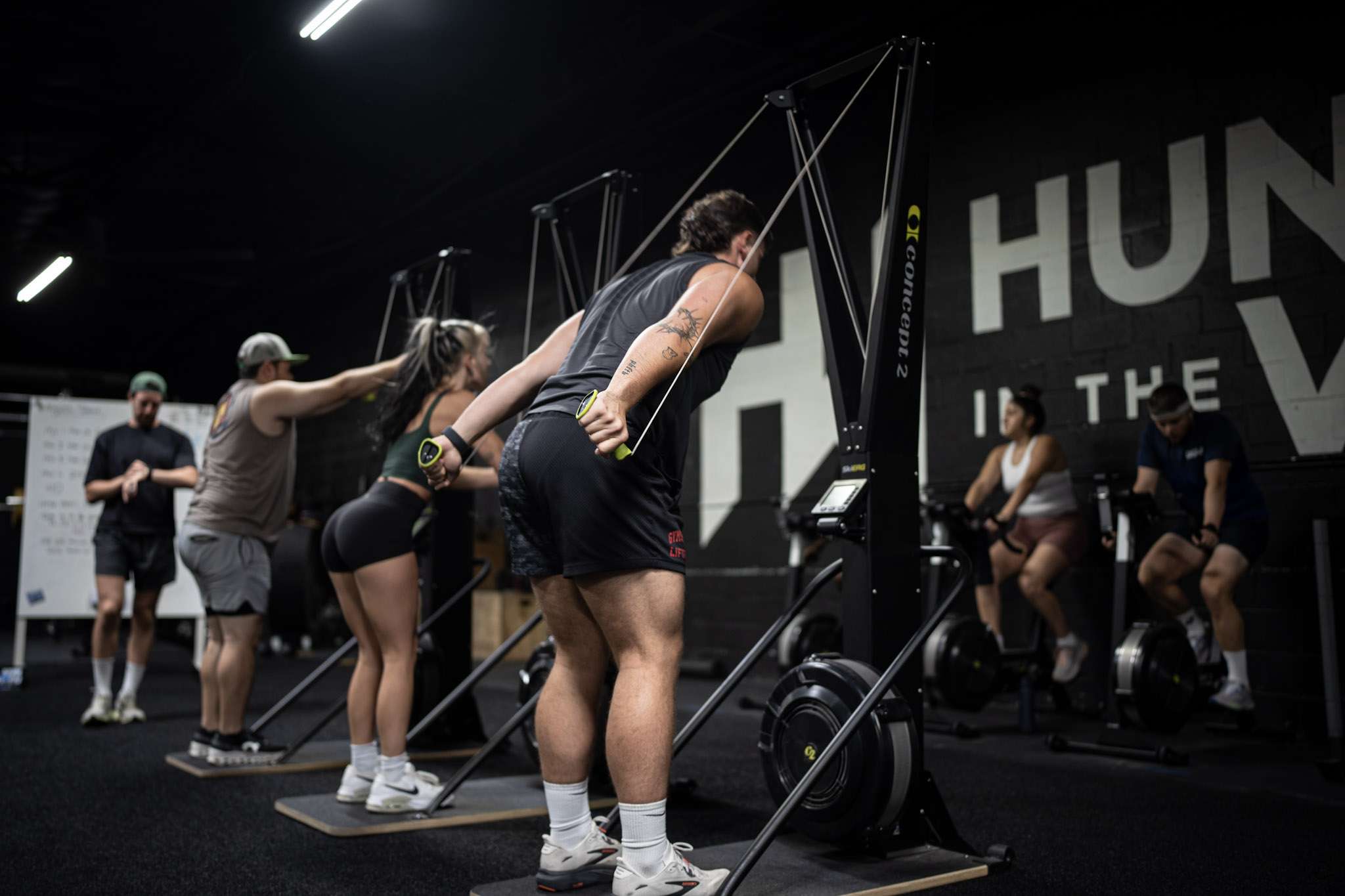
Every HYROX race in the world runs the same course: eight 1-kilometer runs, each followed by one of eight workout stations, always in the same order. That consistency is the whole point — it’s why you can compare your time in Dallas to a race in Berlin — and it’s also your biggest advantage as an athlete. If you know exactly what’s coming, you can train for exactly what’s coming.
This guide walks through all 8 HYROX stations in order — the distances, the weights by division, the movement standards judges actually enforce, and where each station quietly eats your race time. The coach’s tips come from the floor at Hunger in the Wild, Dallas’s official HYROX training club, where we prep athletes for these stations every week. If you’re brand new to the sport, start with our overview of what HYROX is and come back.
After each 1km run, you hit the next station in this fixed sequence:
The order matters strategically. The two heaviest stations (the sleds) come early, the two grippiest (sled pull, farmers carry) are separated, and the race saves its most brutal test — 100 wall balls on destroyed legs — for the very end. Racing well means arriving at station 8 with something left.
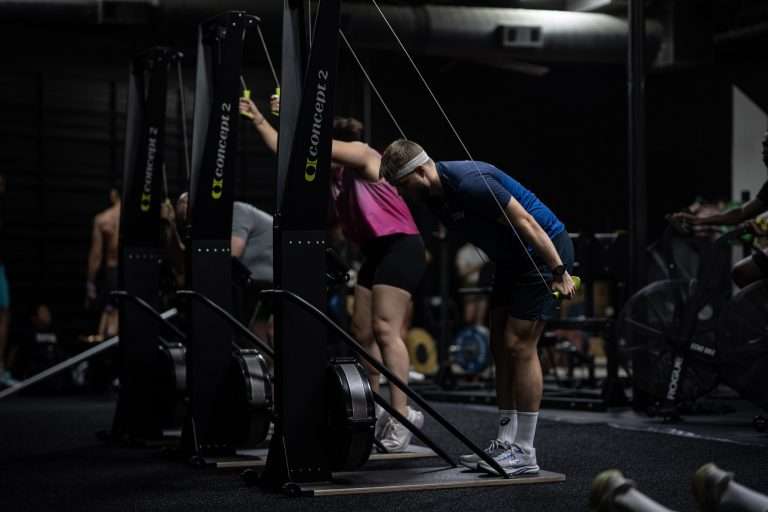
A full-body pull that hits lats, triceps, and core. Both feet must stay on the platform the whole time.
Where time is lost: going out at your all-out erg pace. You just ran a kilometer, and you have seven more to go.
Coach’s tip: Treat it like a hinge, not an arm pull — drive the handles down with your lats and crunch through the core. Settle into a pace about 10–15 seconds per 500m slower than your fresh 1K test pace.
Train it: 4 × 1,000m SkiErg intervals off a 400m run, holding even splits.
Four 12.5m lengths. Total sled weight including the sled itself: 102kg for Open women, 152kg for Open men and Pro women, 202kg for Pro men. You must stay inside your marked lane.
Where time is lost: stalling mid-length. Re-starting a dead sled costs far more than pushing slightly slower but continuously.
Coach’s tip: Low hips, straight arms, small fast steps. Lock your arms into the poles and push with your legs — athletes who bend their elbows turn it into an upper-body exercise and burn out by length three.
Train it: heavy sled pushes at race weight or above, short rest, immediately into a 200m run to teach your legs to run off jelly.
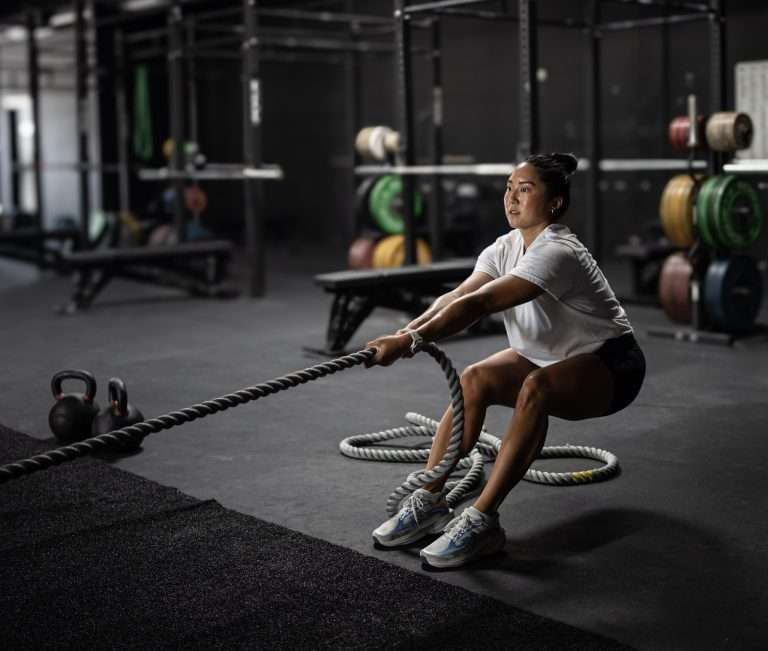
Same four lengths, in reverse: 78kg for Open women, 103kg for Open men and Pro women, 153kg for Pro men. You must stay standing — no seated or kneeling pulling — and stay in your box.
Where time is lost: pulling with just your arms. The rope gets heavier every length that way.
Coach’s tip: Use your bodyweight. Lean back, sit into a quarter squat, and pull the rope with a step-back or explosive hip drive — arms finish what the hips start. Manage the rope with big hand-over-hand strokes rather than short tugs.
Train it: rope sled pulls plus heavy rows and other horizontal pulls; grip endurance work pays double here and at farmers carry.
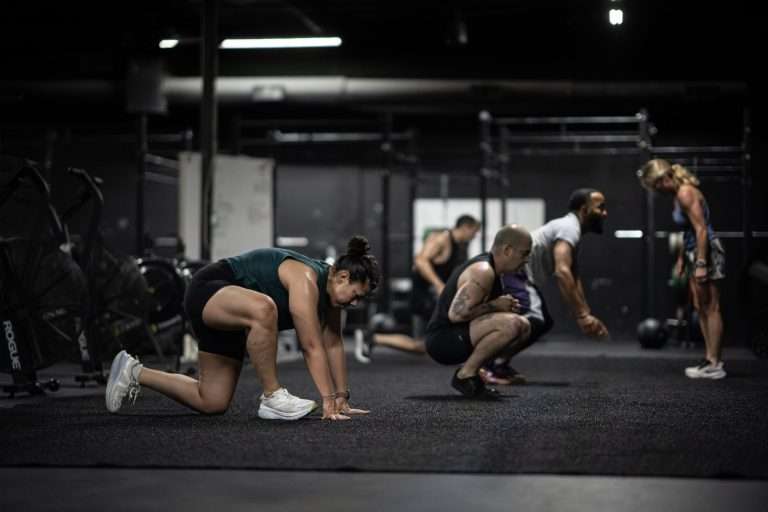
Chest to the ground on every burpee, then a two-foot takeoff and two-foot landing on every jump. Judges no-rep uneven takeoffs.
Where time is lost: this is where pacing mistakes from stations 1–3 come due. Sprinting the first 20 meters then standing with hands on knees is the classic blowup.
Coach’s tip: Pick a sustainable rhythm from meter one — a steady step-down, step-up burpee beats a fast sprawl you can’t hold for 80 meters. Jump for modest, repeatable distance; maximum-effort jumps cost more than they save.
Train it: 20–40m sets at goal race rhythm, focusing on breathing every rep.
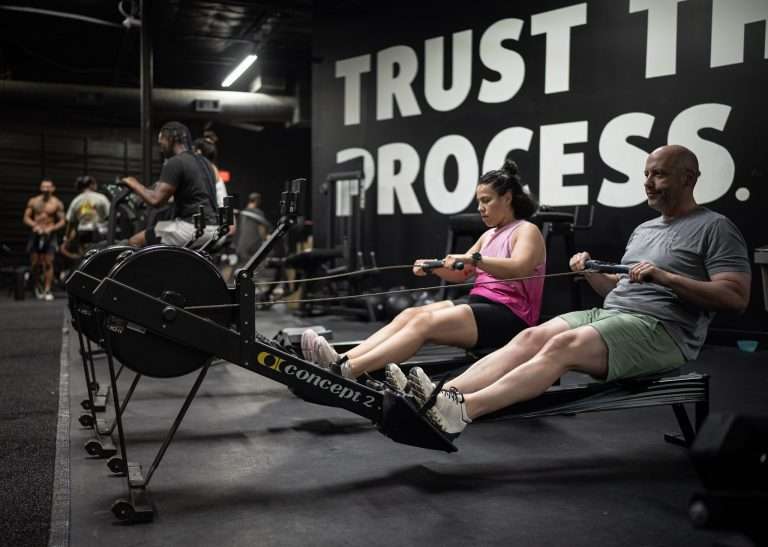
The mid-race reset. You must stay on the seat until all 1,000 meters are done. Damper starts at 6 and you can adjust it freely.
Where time is lost: ironically, by rowing too hard. The row is the one station where the best athletes deliberately give back a few seconds to recover.
Coach’s tip: Long, patient strokes at a stroke rate you can breathe through — legs, body, arms. Use the first 200m to bring your heart rate down from the burpees, then hold a firm but conversational pace. You win the back half of the race here.
Train it: run-row brick intervals; practice finding your “recovery pace” when already gassed.
Two kettlebells — 2×16kg Open women, 2×24kg Open men and Pro women, 2×32kg Pro men — carried at your sides with arms extended.
Where time is lost: setting the bells down. Every drop-and-regrip costs 10+ seconds and shreds your forearms further.
Coach’s tip: Walk fast, don’t run — a hurried shuffle with tall posture and packed shoulders usually beats a jog that forces an early drop. Squeeze the handles hard and breathe; if you must break, do it once at a pre-planned spot, not when the grip fails on its own.
Train it: heavy carries past race weight so race day feels light; pair them with runs.

Sandbag on your shoulders — 10kg Open women, 20kg Open men and Pro women, 30kg Pro men. The trailing knee must clearly touch the ground on every alternating step.
Where time is lost: everywhere. On tired legs this is often the slowest-moving 100 meters of the race, and no-reps for shallow knees make it slower.
Coach’s tip: Short, honest steps with a full knee touch beat long lunges that get you no-repped. Keep the torso tall, drive through the front heel, and find a metronome rhythm — count steps in tens and don’t stop moving.
Train it: walking lunges under load every week, building to unbroken 100m sets. Your wall balls depend on how efficiently you survive this station.
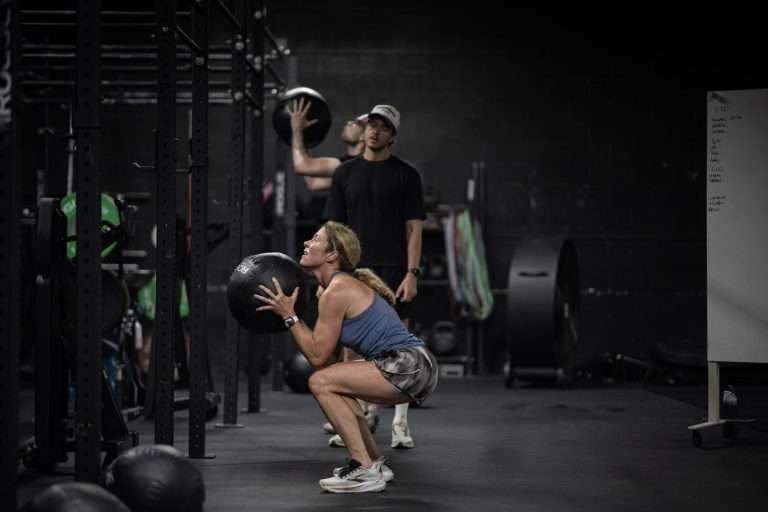
The finale: 100 reps at 4kg to a 2.70m target for Open women, 6kg/2.70m for Pro women, 6kg/3.00m for Open men, 9kg/3.00m for Pro men. Hips below parallel on every squat; there are no warnings, just rep or no-rep.
Where time is lost: giant unbroken sets early, followed by long stares at the wall. Rest periods balloon at the end of a race.
Coach’s tip: Break them before you have to. Planned sets — say 10 × 10 or 5 × 20 with three breaths between — almost always beat “go until I die.” Catch the ball in your squat descent to make each rep one fluid motion, and squat clearly below parallel so nothing gets no-repped when it hurts most.
Train it: high-volume wall ball sets on pre-fatigued legs — lunges or a run first, then structured sets at race standard.
The course is identical for everyone; only the loads change — see our full HYROX weights by division tables. Here’s the quick reference:
| Station | Open Women | Open Men / Pro Women | Pro Men |
|---|---|---|---|
| SkiErg | 1,000m | 1,000m | 1,000m |
| Sled Push (incl. sled) | 102kg | 152kg | 202kg |
| Sled Pull (incl. sled) | 78kg | 103kg | 153kg |
| Burpee Broad Jumps | 80m | 80m | 80m |
| Rowing | 1,000m | 1,000m | 1,000m |
| Farmers Carry | 2×16kg | 2×24kg | 2×32kg |
| Sandbag Lunges | 10kg | 20kg | 30kg |
| Wall Balls | 100 reps, 4kg | 100 reps, 6kg | 100 reps, 9kg |
Doubles divisions split station work between partners (both run every kilometer), and relay teams each take two run-station pairs. Weights occasionally change between seasons, so verify against the official HYROX rulebook before a race — these figures are current for the 2026/27 season.
One more part of the course nobody trains for: the Roxzone, the transition area between runs and stations. Time there counts, and mistakes there cost real penalties — exiting through the wrong arch is a 2-minute penalty. Racing locally? Walk the HYROX Dallas 2026 venue map before your heat so you never think about navigation mid-race.
The most common mistake we see is athletes training the eight stations as eight separate workouts. HYROX doesn’t test your SkiErg or your wall balls — it tests your wall balls after 7km of running and seven stations. That’s why compromised training — pairing stations with runs, back to back, at race standards — is the core of how we program. Strength is the other half: a stronger athlete runs the sleds, carries, and lunges at a lower percentage of their max, which is precisely what strength training for HYROX is designed to build. And before you add volume, make sure you’re not making the classic HYROX training mistakes that stall most first-timers.
If you’d rather not figure it out alone: our HYROX classes in Dallas train every one of these stations on real competition equipment — sleds, SkiErgs, wall ball targets at race height — with coaches who race. First class is free.
SkiErg (1,000m), Sled Push (50m), Sled Pull (50m), Burpee Broad Jumps (80m), Rowing (1,000m), Farmers Carry (200m), Sandbag Lunges (100m), and Wall Balls (100 reps) — each preceded by a 1km run. The order is the same at every HYROX event worldwide.
No. The fixed format is core to HYROX — every race, every city, same course. That’s what makes times globally comparable and the stations so trainable.
Ask ten athletes, get ten answers, but the wall balls break the most races — 100 reps on exhausted legs with strict squat depth. The sled push is the hardest single effort; the sandbag lunges are where slow race times quietly happen.
Burpee broad jumps and wall balls draw the most no-reps: chest must touch the ground and both feet must take off together on the burpees, and hips must clearly break parallel on every wall ball. Train to the judged standard from day one so race day changes nothing.
It helps more than people expect — sled feel varies enormously with surface and sled design, and wall ball targets at exact race height keep your standard honest. That’s why we run our HYROX classes on competition-spec equipment at our Dallas gym.