
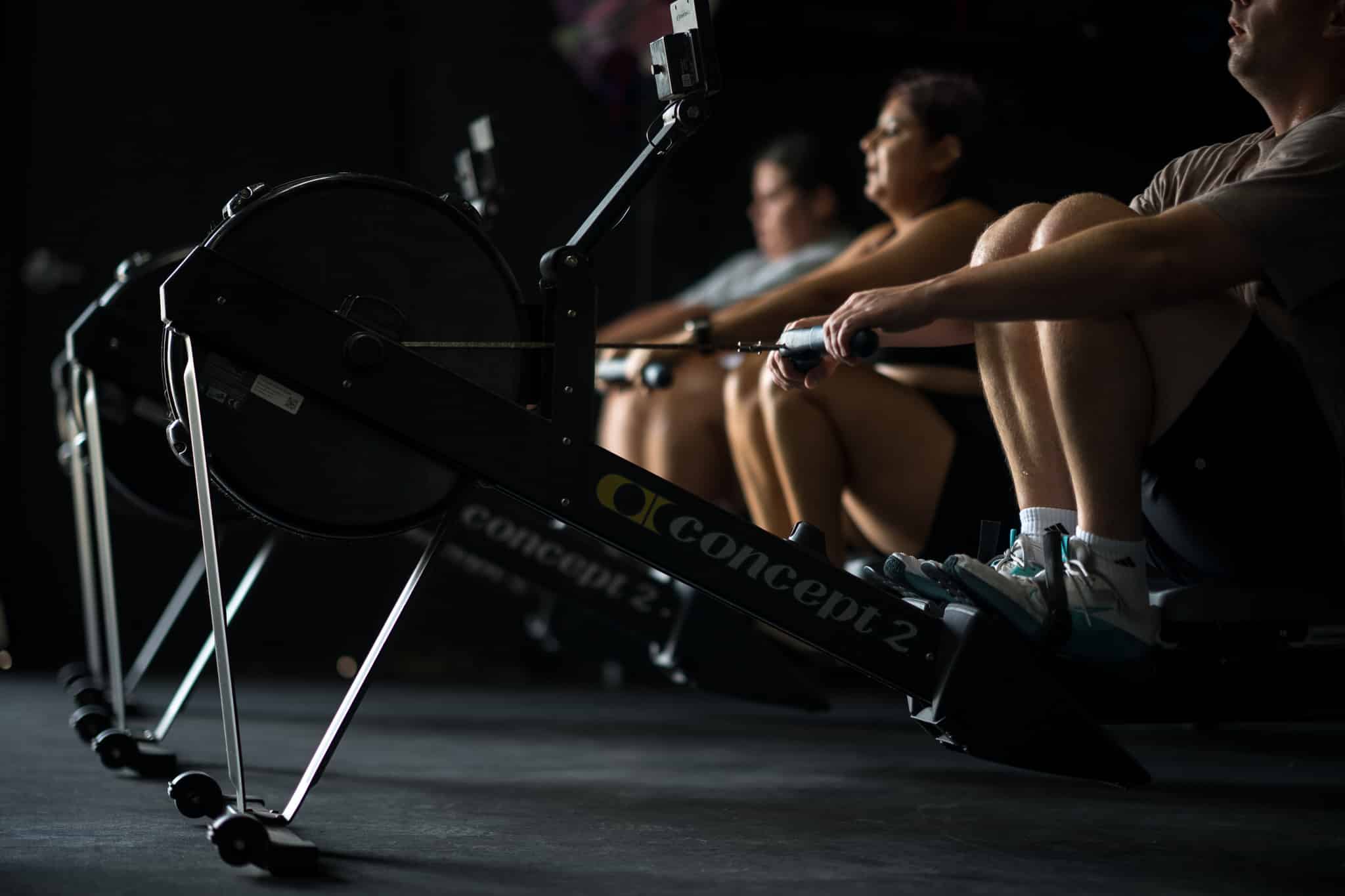
Training for HYROX requires more than being strong or having a good running engine. You have to run 8 kilometers while working through eight functional fitness stations, then maintain your pace, technique, and decision-making as fatigue builds. Effective HYROX training in Dallas should prepare you for all of those demands, not just make you better at individual stations.
At Hunger in the Wild, we train athletes to build the running capacity, strength, conditioning, and race-specific skills HYROX requires. That means developing a strong aerobic base, getting stronger on movements that carry over to the sleds and loaded stations, learning how to run efficiently after hard efforts, and practicing race-specific work as competition gets closer.
Whether you are preparing for your first HYROX or returning with a faster finish time in mind, this guide breaks down how to prepare. We will cover the race format, all eight HYROX stations, running and strength development, weekly programming, race-specific training, and a 12-week framework you can use to understand how preparation should progress as race day approaches.
HYROX creates a programming challenge because athletes need to develop strength and endurance at the same time. Research on concurrent strength and endurance training shows that training adaptations can be influenced by factors such as sex and training status. That is another reason HYROX programming should balance running, strength, and race-specific work rather than simply adding more volume everywhere.
HYROX training combines running, strength development, conditioning, and race-specific station work. Because every race includes eight 1-kilometer runs separated by eight functional fitness stations, athletes need more than the ability to complete each movement individually. You also have to maintain your running pace, manage fatigue, transition efficiently, and perform stations when your heart rate is already elevated.
A complete training plan should develop four areas: running capacity, strength, strength endurance, and race-specific skills. How far ahead you should begin depends on your current fitness and HYROX experience, but your training should become progressively more race-specific as competition approaches. Full race simulations can be useful, but they should not replace the strength, running, and conditioning work that builds the capacity you need on race day.
HYROX is an indoor fitness race that combines running with functional fitness stations in a standardized format. Athletes complete eight 1-kilometer runs for a total of 8 kilometers, with one workout station after each run.
Unlike a traditional running race or strength competition, HYROX requires you to move back and forth between endurance and functional work. You have to run efficiently, handle loaded movements, manage your pace, and continue performing as fatigue builds across the race.
Because the basic race format is standardized across HYROX events, athletes can train specifically for the movements and compare their results across races.
HYROX publishes official rules covering station standards, divisions, penalties, and competition requirements. Because these rules can change between seasons, athletes should review the current HYROX rulebooks before race day.
Every HYROX race follows the same basic sequence: run 1 kilometer, complete one workout station, then repeat until all eight runs and eight stations are finished.
The race order is:
The running distance and station order remain consistent, but loads and some standards vary by division. Current requirements should always be checked against the official HYROX race information before competition.
That consistency is one of the reasons HYROX can be trained so specifically. You know which stations are coming, how far you have to run, and where each movement appears in the race. The challenge is developing enough capacity to execute that work efficiently when fatigue starts accumulating.
HYROX sits between traditional endurance racing and strength-based functional fitness. Running accounts for 8 kilometers of the race, but athletes also have to push and pull sleds, carry kettlebells, perform lunges, complete burpee broad jumps, work on the SkiErg and rower, and finish with wall balls.
That combination means HYROX performance cannot be reduced to a single quality.
A strong athlete who has not developed enough running capacity can lose significant time between stations. A good runner who lacks strength may struggle with sleds, carries, lunges, or repeated wall balls. An athlete with both qualities can still underperform if pacing is too aggressive or station efficiency breaks down under fatigue.
Effective preparation therefore has to develop several qualities together:
The goal is not to turn every training session into a HYROX race. It is to build each physical quality separately when needed, then progressively combine them as race day gets closer.
HYROX offers several ways to race depending on your experience, goals, and whether you want to compete individually or with teammates.
Open: The standard individual HYROX division. You complete all eight runs and all eight workout stations yourself using the Open division loads and standards.
Pro: An individual division for experienced athletes that follows the same race structure but increases the load on several workout stations.
Doubles: Two athletes run the 1-kilometer segments together and divide the work at each station between them. Doubles categories include men’s, women’s, and mixed teams, with Pro options available for qualifying men’s and women’s teams under current competition rules.
Relay: A team of four divides the race. Each athlete completes two 1-kilometer runs and two workout stations, making Relay a different way to experience the HYROX format without completing the entire individual race.
HYROX also recognizes Adaptive divisions for eligible athletes, with specific classifications and competition standards. Race offerings can vary by event, so athletes should confirm available categories and current requirements before registering.
Choosing a division should be based on your experience, current fitness, and race goals rather than simply choosing the hardest available option. First-time racers often use Open or Doubles to learn the demands of the event, while experienced competitors may choose Pro when they are prepared for the heavier station loads.
 The 8 HYROX Stations Explained
This section is the most important reference you will find for understanding HYROX race requirements. All weights below are for the Open category. Men’s Open and Women’s Open weights differ, and both are listed.
Men Open: Bodyweight only (no added load)
Women Open: Bodyweight only (no added load)
The SkiErg is the first station you hit after your opening 1 km run, which makes pacing critical. On the Concept2 SkiErg, you pull both handles down simultaneously in a double-pole skiing motion while driving your hips back and engaging your core. The movement is full-body: lats, core, glutes, and quads all contribute. Athletes who treat it as an arm exercise blow up quickly.
Efficient SkiErg technique involves more than pulling hard with your arms. Concept2’s SkiErg technique guidance emphasizes engaging the core and using a hip hinge to help generate an efficient double-pole movement. For HYROX athletes, the goal is to use that full-body pattern without turning the opening station into an all-out effort.
Technique tip: Aim for 30-35 strokes per minute at race pace. Start the first 300m at roughly 70-75% effort, build through the middle 400m, and finish strong over the final 300m. Long, controlled strokes generate more power than short, choppy pulls.
Common mistakes: Going out too hard in the first 200m, hunching the back instead of hinging at the hips, and failing to use leg drive. A second mistake is ignoring the SkiErg in training entirely because it feels “easy” at low intensities. At race pace, after a run, it is a different machine.
Men Open: 152 kg total including the sled
Women Open: 102 kg total including the sled
The sled push covers 50 meters, which is laid out as 4 lanes of 12.5m each. You must push the sled forward using low handles, driving through your legs while keeping your torso nearly parallel to the ground. Failing to complete all four lanes results in a 3-minute time penalty.
Technique tip: Keep your hips low and drive through your heels, not your toes. Short, powerful strides are more sustainable than long lunging steps. Breathe out on each drive, not in. Many athletes hold their breath instinctively, which accelerates fatigue dramatically.
Common mistakes: Standing upright as the sled gets heavier (this shifts load to your lower back instead of your legs), losing contact between hands and handles, and starting too fast on the first lane only to stall out on lanes 3 and 4. Train at or above race weight regularly so race-day weight feels manageable.
Men Open: 103 kg total including the sled
Women Open: 78 kg total including the sled
The sled pull uses a rope attached to the sled. You walk backward, pulling hand-over-hand while the rope accumulates at your feet. Like the push, this is 4 lanes of 12.5m. The same 3-minute penalty applies for incomplete lanes.
Technique tip: Keep your hips slightly lower than your shoulders and use your whole body, not just your arms. Reset your grip quickly between pulls. Short, quick hand placements beat long, slow pulls when fatigue sets in. Keep the rope organized at your feet to avoid tripping.
Common mistakes: Leaning too far back, which causes you to pull backward instead of downward. Gripping too tight too early, which burns out your forearms before the Farmer’s Carry and Wall Balls later. Practice with race-weight loads consistently in training. Approximating this station with elastic bands or light attachments does not replicate the friction-based resistance of a loaded sled on competition flooring.
Men Open and Women Open: Bodyweight only, 80m total distance
This station has no external load, but it earns a reputation as the great equalizer. You perform a burpee (chest to floor, push up, jump up) and then immediately jump forward as far as possible. You cannot step between repetitions: each jump must immediately follow the burpee. The station ends when you jump across the finish line. Each invalid repetition results in a 5m distance penalty.
Technique tip: Find a rhythm and protect it. Going too fast early creates sloppy burpees and penalties. A consistent pace is faster overall than sprinting and crashing. On the jump, use your arms to generate forward momentum: swing them hard as you leave the ground.
Common mistakes: Taking small jumps to “save energy.” Longer jumps mean fewer total reps to cover 80m, which is almost always more efficient than short jumps done faster. Also, failing to fully extend at the top of the burpee results in no-reps and time penalties. Practice the full range of motion in training, especially when fatigued.
Men Open and Women Open: Bodyweight only on a Concept2 RowErg
The rowing station comes at the halfway point of the race, after four stations and five 1 km runs. Your legs are already taxed from the sled work and running. The row demands both aerobic capacity and mechanical efficiency.
Technique tip: The rowing drive sequence is legs first, then back, then arms. On the recovery, the sequence reverses: arms away, lean forward, then slide the seat back. A common race mistake is pulling with the arms first, which turns the stroke inefficient and tires the upper body unnecessarily. Target a stroke rate of 24-28 strokes per minute for most athletes. Too fast a rate sacrifices power per stroke. Aim for 500m splits in the 2:00-2:15 range depending on your fitness level.
Common mistakes: Slumping in the seat as fatigue sets in, which compresses the lungs and reduces power. Rushing the catch (the front of the stroke) instead of allowing a controlled transition. Setting your damper (drag factor) too high, which makes every stroke harder and increases fatigue on a long race day.
Men Open: 2 x 24 kg kettlebells (one in each hand)
Women Open: 2 x 16 kg kettlebells (one in each hand)
The Farmer’s Carry covers 200 meters, making it the longest carry station in the race. You carry the kettlebells at your sides, walking the full distance without setting them down (though you may set them down and rest briefly, this costs significant time).
Technique tip: Pack your shoulders back and down. Let the kettlebells hang at arm’s length without shrugging them upward. Your core braces throughout. Short, quick steps are slightly more efficient than long strides because they reduce lateral swing of the implements. Practice long, unbroken sets to build grip endurance.
Common mistakes: Rushing the first 100m and burning out your grip halfway through. Gripping too tightly in the fingers rather than across the palm, which accelerates forearm fatigue. The single most important accessory training habit for the Farmer’s Carry is building grip strength through consistent heavy carries and dead hangs.
Men Open: 20 kg sandbag
Women Open: 10 kg sandbag
You carry the sandbag across your shoulders (front rack or bear hug position) and complete alternating forward lunges for 100 meters. Each rep requires your back knee to make contact with the ground. Steps between lunges are not permitted.
Technique tip: Keep your torso upright throughout each lunge. A forward lean shifts load into your lower back and makes the movement harder to sustain. Drive through your front heel to stand up. Finding a steady rhythm is more important than moving fast: lunges deteriorate quickly when pacing breaks down late in the race.
Common mistakes: Failing to touch the back knee to the floor, resulting in no-rep penalties. Carrying the sandbag too far forward on the shoulders, which pulls the torso forward and creates a chain reaction of poor mechanics. Practice weighted lunges in training at or above race weight for distances of at least 50-100m without stopping.
Men Open: 6 kg ball, 10-foot target
Women Open: 4 kg ball, 9-foot target
The final station. You hold the medicine ball at chest height, squat below parallel, and as you drive upward, throw the ball to hit the target. The ball must hit the designated metal target, not just clear the height. Each repetition requires a below-parallel squat, a full hip extension, and a clean strike on the target.
Technique tip: Catch the ball in the “loading position” at the top of your squat rather than letting it fall and re-catching from standing. This creates a continuous rhythm and dramatically reduces the energy cost of 100 reps. Find your optimal standing distance from the wall by practicing before race day: standing too close creates a steep throw angle; too far means fighting for distance.
Common mistakes: Shallow squats that result in no-reps. Rushing and breaking down mechanics while exhausted from seven previous stations and eight km of running. The best strategy is to aim for unbroken sets of 20-25 reps with controlled short rests, rather than grinding out singles when you hit failure.
Training for HYROX is not complicated, but it requires honesty about what the race actually demands. Three pillars govern effective HYROX preparation.
You will run 8 kilometers during a HYROX race, broken into 1 km segments. None of those segments feel like a fresh, standalone 1 km effort because each one follows a station and precedes another. That means your running training must address both aerobic base and compromised running.
Zone 2 running builds the aerobic engine that powers you through the full event. Run at a conversational pace, 3-4 times per week, building your weekly volume gradually. Most competitive HYROX athletes target 30-50 km of weekly running volume during their peak training phase.
Running intervals (800m to 1,000m repeats at 10K pace) train your ability to run at race pace when your heart rate is already elevated. These efforts should feel controlled, not all-out.
Compromised running is the most HYROX-specific running work you can do. This means running immediately after completing a station, mimicking race conditions. A typical session might include: 1 km run, then sled push, then 1 km run, then Farmer’s Carry. The ability to restart your running rhythm after strength work is a skill that only comes from practicing it repeatedly.
HYROX requires a specific type of strength: muscular endurance under load, not one-rep max power. Your training should prioritize compound movements that mirror station mechanics.
HYROX athletes should not treat strength work as optional simply because the event includes substantial running and conditioning. Research reviewing strength training and endurance performance has found that combining endurance work with heavy or explosive strength training can improve measures such as running economy and endurance performance in trained athletes.
Key movements to develop:
The key is training these movements at race-relevant distances and loads, not simply lifting heavy for low reps in isolation. A set of 8 goblet squats builds muscle. Forty meters of sandbag lunges at race weight builds what you actually need on competition day.
Race simulation is where HYROX preparation separates itself from general fitness training, and it is the hardest component to replicate without the right equipment and environment.
A full race simulation runs you through all eight stations in order, each preceded by a 1 km run. Partial simulations (3-4 stations and runs) are also effective and can be integrated into weekly training throughout your prep cycle. The purpose of simulation is not just to build fitness. It is to teach your nervous system and your pacing instincts what the real race feels like, so that on competition day, nothing is a surprise.
Race-specific equipment becomes increasingly valuable as competition approaches because it allows athletes to practice the movement, loading, setup, and transitions they will encounter on race day. Training on a SkiErg, RowErg, sled, kettlebells, sandbags, and wall-ball setup that closely matches competition conditions can help athletes become more familiar with how each station feels and how to approach it efficiently.
That does not mean every training session requires exact race equipment. Substitute exercises can still develop the physical qualities HYROX demands. Heavy squats and deadlifts can build strength for loaded stations, carries can develop grip and trunk strength, running intervals can improve conditioning, and other resistance exercises can help build the muscular endurance required throughout the race.
The difference is general preparation versus race-specific preparation. Early in a training cycle, building strength, aerobic capacity, and movement quality may matter more than perfectly replicating every station. As race day gets closer, specificity becomes more important.
At Hunger in the Wild, we progressively introduce more race-specific work as athletes move through their training cycle. That gives athletes time to build the physical capacity they need first, then learn how to apply it to the exact demands of HYROX.
The goal is not to simulate the entire race every time you train. It is to arrive on race day already familiar with the equipment, loads, movement standards, pacing demands, and transitions you will encounter.
This distinction matters more than most athletes realize when they start their search.
An official HYROX Training Club is equipped with the same implements used in actual races: HYROX-certified competition sleds, Concept2 SkiErg and RowErg machines, race-spec wall ball targets at correct heights, regulation sandbags, and kettlebells at official competition weights. When you train on race-standard equipment, you eliminate variables. You know exactly what the sled feels like at 152 kg. You know your split times on the Concept2 SkiErg. You know what 100 wall ball reps feel like on a competition target.
At Hunger in the Wild, every piece of equipment you train on is the same category of equipment used in HYROX races. That is not an accident. It is the entire point.
A generic training plan found online cannot respond to your movement patterns, your current fitness baseline, your injury history, or your specific race date. Our coaches at Hunger in the Wild provide structured, periodized programming that adapts across your training cycle. Classes are designed to progress systematically, not just deliver random hard workouts.
The difference between doing 100 wall balls correctly and doing them with chronic knee drift and a shallow squat is the difference between a legal rep on race day and a penalty. Our coaches catch those mechanics in training so you never face them during a race.
Hunger in the Wild is an Official HYROX Training Club — HYROX’s affiliate designation for gyms that meet its standards for equipment, coaching, and programming. That status is verified directly with HYROX, not a marketing claim.
What sets us apart in Dallas isn’t a fancier label. It’s the coaching: race-standard equipment on every station, programming built specifically around what HYROX actually demands on race day, and coaches who compete in HYROX themselves rather than just running you through a workout.
This framework is not a day-by-day prescription. It is a phase structure to guide your preparation regardless of your current fitness level. Work with our coaches at Hunger in the Wild to adapt this framework to your specific race date and baseline.
The first four weeks are about establishing the foundation you will build on. The goals are straightforward: develop your running base, learn the correct movement standards for every station, and build fundamental strength.
Typical weekly structure:
By the end of Week 4, you should be running consistently, moving efficiently on all stations, and building the habit of training in HYROX-specific patterns.
This phase increases intensity and specificity. Station weights progress toward or above race weight. Compromised running becomes longer and harder.
Key progressions:
The goal of this phase is building the engine that can handle race-specific demands, not just isolated fitness.
This is where race-specific training peaks. Full or partial race simulations enter the weekly program. All station work happens at or near race weight. Running volume may slightly reduce as intensity increases.
Key sessions:
By the end of Week 11, you should have completed at least one full race simulation and know your pacing targets for each station.
Reduce volume, maintain intensity. This is not the week to get extra reps in. Trust the work you have done.
Taper protocol:
On race day, you will be fresher and stronger than any other day in your training cycle. That is the goal of the taper.
HYROX Dallas races are held at the Kay Bailey Hutchison Convention Center, one of the largest convention venues in the country. The indoor format is ideal for a HYROX event: climate controlled, large enough to accommodate multiple divisions and thousands of athletes, and located centrally in downtown Dallas.
Athletes from across Texas and the broader southern region travel to the Dallas race, making it one of the premier HYROX events in the United States. If you are based in DFW, you have the advantage of training in the same city where you will race, eliminating the logistics burden of travel.
Our official HYROX Training Club is located at 1350 Manufacturing St, Suite 204, Dallas TX 75207, in the heart of the Dallas Design District. The Design District location is intentional: it sits at the intersection of Dallas’s most active fitness community and its most creative professional neighborhoods, making it accessible from Uptown, Oak Lawn, Victory Park, and the broader inner loop.
We offer structured HYROX training classes on a schedule built around working athletes:
Wednesday classes: 6:00 AM, 7:00 AM, 5:30 PM
Saturday classes: 8:00 AM, 9:00 AM
Membership pricing is $220 per 4-week cycle, with options to fit different training frequencies. Every class is coach-led, programmed specifically for HYROX race preparation, and conducted on race-standard equipment.
With 300+ five-star reviews and a 5.0-star rating, Hunger in the Wild has built a reputation as the destination for serious HYROX athletes in Dallas. That is not an accident. It comes from coaches who train and race HYROX themselves, running programming built around what the race actually demands.
 5 Things Every HYROX Athlete Needs to Train
The standard recommendation is 12 weeks of structured preparation, assuming you have a reasonable fitness base: the ability to run 5 km comfortably and some experience with strength training. Beginners with lower fitness starting points may benefit from a 16-20 week preparation window. Athletes with a strong hybrid fitness background (running plus functional strength) can prepare effectively in 8-10 weeks. The key variable is not just time but specificity: training in a facility with the right equipment and a structured HYROX program compresses your learning curve significantly compared to training on generic equipment with a generic plan.
To train properly for HYROX, you need access to: a Concept2 SkiErg, a competition-standard sled (push and pull), a Concept2 RowErg (rowing machine), a wall ball with a target at the correct height (9 ft for Women Open, 10 ft for Men Open), kettlebells at race weight for Farmer’s Carry, a sandbag at race weight for lunges, and adequate flooring for sled work. This is precisely why training at an official HYROX Training Club matters: you cannot improvise your way to race-specific preparation. At Hunger in the Wild, all of this equipment is available in every class.
Yes. The Open division is designed to be accessible for well-trained recreational athletes, and many first-time HYROX competitors are fitness beginners relative to elite sport. What HYROX requires is consistent, structured preparation. Most beginners who commit to a 12-week training program with an official HYROX Training Club cross the finish line successfully on their first race. The atmosphere at HYROX events is strongly community-oriented: finishing is celebrated, and first-timers are a core part of every wave.
A HYROX Training Club is HYROX’s official affiliate designation for gyms that meet its equipment, coaching, and programming standards — that’s the tier Hunger in the Wild holds, verified directly with HYROX. A HYROX Performance Center is a separate, higher-investment designation tied to hosting race-scale official facilities; Dallas’s first Performance Center was awarded to Gold’s Gym in 2025. Being a Training Club doesn’t mean lesser coaching — the day-to-day training experience comes down to the gym itself. Hunger in the Wild is Dallas’s Official HYROX Training Club, with race-standard equipment on every station and coaches who compete in HYROX themselves.
If you are searching for a HYROX gym near me in Dallas or HYROX training near me Dallas TX, the answer is straightforward: Hunger in the Wild at 1350 Manufacturing St, Suite 204, Dallas TX 75207 is an Official HYROX Training Club in the Dallas Design District. You can reach us at (682) 558-3165 or visit our website at hungerinthewild.com to view the class schedule and membership options. Classes run on Wednesdays (6:00 AM, 7:00 AM, 12:00 PM, 5:30 PM) and Saturdays (8:00 AM, 9:00 AM).
For the Open category in the 2024-25 HYROX season, the official weights are as follows:
| Station | Men Open | Women Open |
|---|---|---|
| SkiErg (1,000m) | Bodyweight | Bodyweight |
| Sled Push (50m) | 152 kg incl. sled | 102 kg incl. sled |
| Sled Pull (50m) | 103 kg incl. sled | 78 kg incl. sled |
| Burpee Broad Jumps (80m) | Bodyweight | Bodyweight |
| Rowing (1,000m) | Bodyweight | Bodyweight |
| Farmer’s Carry (200m) | 2 x 24 kg | 2 x 16 kg |
| Sandbag Lunges (100m) | 20 kg | 10 kg |
| Wall Balls (100 reps) | 6 kg, 10 ft target | 4 kg, 9 ft target |
These are the definitive competition standards. Any training program that uses different loads or distances is not providing authentic race preparation.
If you are serious about competing in HYROX, training at an official HYROX Training Club gives you every advantage over athletes preparing on generic gym equipment or following uncoached plans. You will train on race-standard equipment, under coaches who understand the specific demands of the race format, in a community of athletes with the same goalsHunger in the Wild is Dallas’s official HYROX Training Club, located at 1350 Manufacturing St, Suite 204, Dallas TX 75207 in the Design District. We offer a free introductory session so you can experience the training environment, meet our coaches, and determine whether our program is the right fit for your race goals.
 Ready to start training?
Book a Free Intro Session | View HYROX Classes | Explore All Classes
Call us at (682) 558-3165 or visit us at 1350 Manufacturing St, Suite 204, Dallas TX 75207. Classes run Wednesdays at 6:00 AM, 7:00 AM, and 5:30 PM, and Saturdays at 8:00 AM and 9:00 AM.
Your next HYROX race starts here!